
SGPA to CGPA Calculator – Calculate Your Cumulative CGPA
Enter your semester SGPAs to calculate your cumulative CGPA quickly and accurately.
✅ Free to use · Multiple semesters · Equal-weight & credit-weighted calculations

🎓 SGPA to CGPA Converter
What Is an SGPA to CGPA Calculator?
An SGPA to CGPA calculator combines your semester grade point averages into one cumulative grade point average.
SGPA (Semester Grade Point Average) represents your academic performance for one semester.
CGPA (Cumulative Grade Point Average) represents your overall academic performance across multiple completed semesters.
For example, if your SGPAs are 7.5, 8.0, 8.2, and 8.5, your CGPA can be calculated from those semester scores when they have equal weighting.
Use the calculator above to enter your semester SGPAs and calculate your cumulative score.
How to Calculate CGPA from SGPA
The calculation method of CGPA from SGPA depends on how your university weights semesters.
Method 1: Equal-Weight Semester Average
If all completed semesters have equal credit weight, you can calculate CGPA by taking the average of your SGPA.
Formula:
CGPA = (SGPA₁ + SGPA₂ + SGPA₃ + ... + SGPAₙ) ÷ n
Where:
Example
Suppose your semester SGPAs are
Add the semester scores:
7.5 + 8.0 + 8.2 + 8.5 = 32.2
Then divide by 4:
32.2 ÷ 4 = 8.05
Your CGPA is 8.05 using the equal-weight method.
Method 2: Credit-Weighted CGPA
A simple average is not always appropriate.
If your semesters have different credit weights, your university may calculate the cumulative result using a weighted method.
Formula:
CGPA = [(SGPA₁ × Credits₁) + (SGPA₂ × Credits₂) + ...] ÷ Total Credits
Example
Suppose your semester results are
Semester | SGPA | Credits |
Semester 1 | 8.0 | 20 |
Semester 2 | 8.5 | 22 |
Semester 3 | 9.0 | 24 |
Calculate each weighted score:
Total weighted score:
160 + 187 + 216 = 563
Total credits:
20 + 22 + 24 = 66
CGPA:
563 ÷ 66 = 8.53
So the credit-weighted CGPA is 8.53.
If your university uses credit-based calculations, use the credit information shown on your academic records and follow its prescribed calculation method.
Which CGPA Method Should You Use?
Use the method that matches your university's calculation rules.
Use simple averaging when:
Use a credit-weighted calculation when:
If you are unsure, check your university's academic regulations, examination handbook, or official grade documentation before calculating your final CGPA.
Can One SGPA Be Converted Directly to CGPA?
No. A single SGPA does not normally provide enough information to determine a cumulative CGPA.
SGPA represents one semester, while CGPA combines performance across multiple completed semesters.
For example, if your Semester 1 SGPA is 7.5, your final CGPA cannot be determined from 7.5 alone.
If your later SGPAs are
Then, using an equal-weight calculation:
(7.5 + 7.8 + 8.0 + 7.9) ÷ 4 = 7.80
Your CGPA is therefore 7.80, not simply 7.5.
If you maintain the same SGPA in every semester, the resulting CGPA will remain the same under an equal-weight calculation.
What Is the Difference Between SGPA and CGPA?
SGPA | CGPA |
Measures performance for one semester | Measures cumulative performance |
Calculated for a single academic term | Calculated across completed semesters |
Changes after each semester | Updates as additional semesters are completed |
Appears on semester-level academic records | May appear on cumulative or final academic records |
In simple terms:
SGPA = one semester
CGPA = cumulative performance
Your SGPA can change significantly from one semester to another, while your CGPA changes gradually because it includes previous academic performance.
Common SGPA to CGPA Calculation Mistakes
Using a simple average when credits are weighted
If your university uses credit-weighted calculations, simply adding SGPAs and dividing by the number of semesters can produce an incorrect result.
Check your university's calculation method first.
Rounding SGPAs too early
Keep the available decimal values during the calculation and round the final CGPA according to your university's rules.
For example, avoid replacing 8.78 with 8.8 before completing the calculation unless your institution specifically requires that rounding.
Mixing different grading scales
Do not combine scores from different grading scales without first determining how your institution handles the change.
For example, a 10-point SGPA and a 4-point GPA should not simply be added together.
Ignoring university-specific rules
Some institutions may have specific rules for credits, repeated courses, grade improvements, failed courses, or cumulative calculations.
Your university's official regulations should take priority over a generic calculation.
SGPA to CGPA Examples
Here are some simple equal-weight examples:
Semester SGPAs | CGPA |
7.5, 7.5 | 7.50 |
7.5, 8.0 | 7.75 |
8.0, 8.5 | 8.25 |
8.0, 8.5, 9.0 | 8.50 |
7.5, 8.0, 8.5, 9.0 | 8.25 |
8.5, 8.5, 9.0, 9.0 | 8.75 |
These examples assume that all semesters have equal weighting.
For credit-weighted programs, your result may be different.
How Does the Calculator Work?
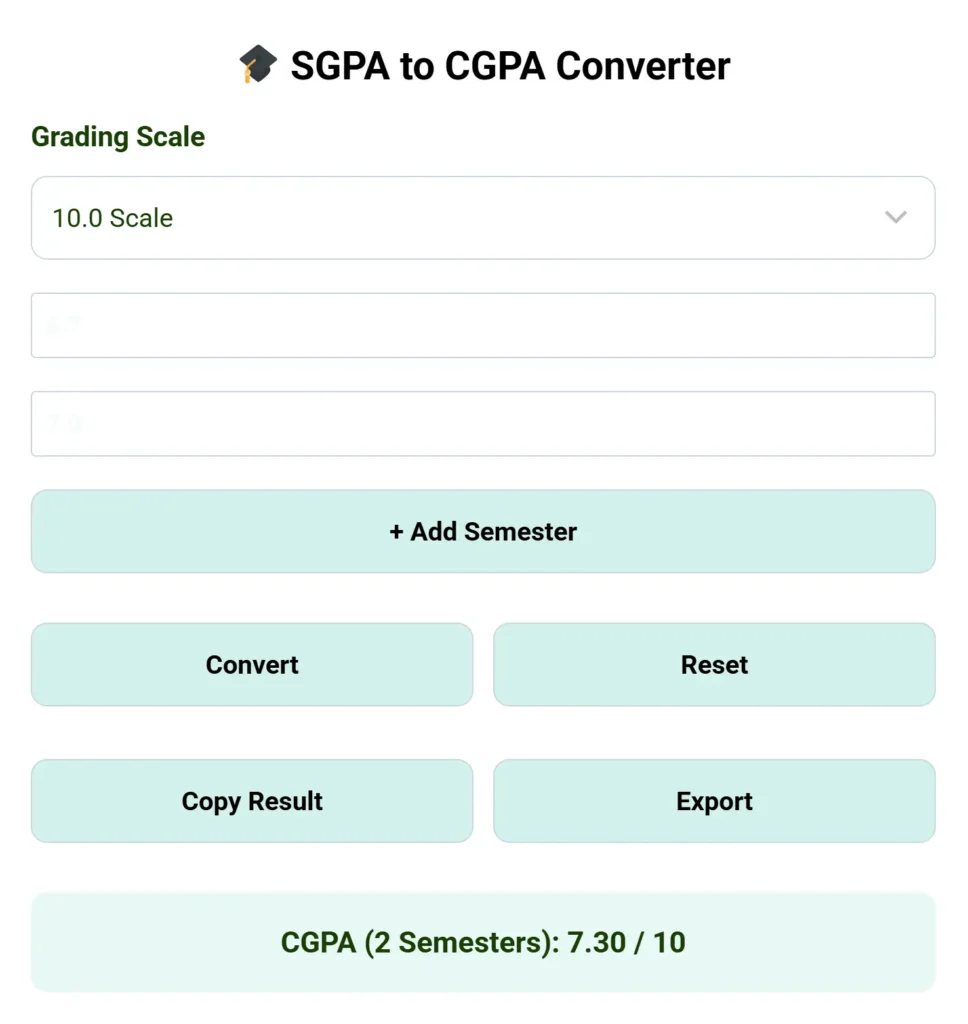
Our SGPA to CGPA calculator lets you enter your semester scores and calculate your cumulative result without performing the calculation manually.
Step 1: Select your grading scale.
Choose the grading scale applicable to your academic system.
Step 2: Enter your semester SGPAs.
Enter the SGPA for each completed semester.
Step 3: Add more semesters
Use the Add Semester option if you have more than two semesters.
Step 4: Calculate
Select Convert to calculate your CGPA.
Step 5: Review or save your result
You can review the calculated CGPA and use the available options to copy or export the result.
What If My University Uses a Different CGPA Formula?
University calculation rules can differ.
The calculator provides a general way to combine semester SGPAs, but your institution's official calculation method should take priority if it uses a different formula or weighting system.
Check:
If your university specifies a particular method, use that method for official academic purposes.
Frequently Asked Questions
Calculate Your CGPA
Enter your semester SGPAs in the calculator above to calculate your cumulative CGPA.
For the most accurate academic result, use the calculation method specified by your university and keep your original SGPA and credit values until the final calculation.
Methodology Note
GPA Converter Hub provides calculation tools designed to simplify common academic calculations. General formulas shown on this page are intended for educational and reference purposes. When an institution provides its own official calculation method, that method should be used for academic, admission, scholarship, or employment purposes.

About the Author
Mian Saqib Rasheed
Founder of GPA Converter Hub | Civil Engineering Graduate
Mian Saqib Rasheed is the founder of GPA Converter Hub and a civil engineering graduate. Inspired by challenges he faced while calculating GPA, CGPA, and academic percentages during university, he created this platform to help students access accurate educational calculators and resources.