
Percentage Calculator – Calculate Marks Percentage in 5 Seconds
Use our Marks Percentage Calculator to quickly convert your obtained marks into a percentage. Get accurate results instantly without any manual calculations.
✅ No Formula Needed — Get Your Percentage Now

Calculating your exam score shouldn’t feel like solving a math puzzle. Whether you're checking your test results, converting marks into percentages, or tracking your academic performance, a reliable percentage calculator makes everything quick and stress-free.
Students often get confused when dealing with multiple subjects, total marks, or different scoring systems. Instead of manually applying formulas every time, you can simply enter your scored marks and total marks to instantly calculate percentage with accuracy. For CGPA-based systems, you can also use our CGPA to Percentage Calculator to convert your grades into percentages easily.
This tool is designed for:
Along with the calculator, this guide will also help you understand:
So whether you're preparing for exams or just checking your score, this marks-percentage calculator will save you time and give you precise results in seconds.
Free Percentage Calculator (Instant Results)
Use this simple and accurate percentage calculator to quickly calculate your marks in seconds. If you're working with GPA systems, try our GPA calculator to calculate your academic performance more efficiently.
Whether you’re checking a single test score or combining multiple subjects, this tool gives you instant and reliable results without any manual calculation.
How to Use the Calculator
Using the calculator is very easy:
- Enter your scored marks (the marks you obtained)
- Enter the total marks (maximum possible marks)
- Click the 'Calculate' button.
- Instantly get your percentage result
That’s it: no formulas, no confusion.
What You Can Calculate
This marks percentage calculator is useful for the following:
Why Use This Calculator?
Works for all exams: school, college, or competitive tests
Marks to Percentage Calculator - Simple Guide
Understanding how to convert your marks into percentages is important for evaluating your academic performance. While the percentage calculator gives instant results, knowing the method helps you avoid confusion and double-check your scores.
How to Calculate the Percentage of Marks
To calculate the percentage of marks, you only need two values:
The process is simple:
Divide the obtained marks by the total marks
Multiply the result by 100
This gives you your final percentage.
For example, if you scored 80 marks out of 100:
80 ÷ 100 × 100 = 80%. So your percentage is 80%.
Marks to Percentage Formula
Here is the standard formula used in schools, colleges, and exams:
Percentage = (Obtained Marks ÷ Total Marks) × 100
This formula works for:
Why This Formula Works
The formula converts your marks into a value out of 100. Since "percentage" means “per hundred", multiplying by 100 helps standardise your score so it can be easily compared.
This is why percentages are widely used in the following:
Percentage Calculation Core Examples
Understanding formulas is good, but real-life examples make things crystal clear. Below are some practical examples to help you use the percentage calculator more effectively.
Single-Subject Example
Let’s start with a simple case.
Suppose you scored 45 marks out of 50
Now apply the formula:
45 ÷ 50 × 100 = 90%
Your final percentage is 90%.
This is the easiest type of calculation and works for any single test or subject.
Multiple Subjects Example
Now, let’s take a more realistic student scenario.
Marks obtained:
Total marks:
Step 1: Add obtained marks
80 + 70 + 90 = 240
Step 2: Apply the formula
240 ÷ 300 × 100 = 80%
✔ Final percentage = 80%
Another Example (Different Total Marks)
Suppose you scored:
Calculation:
18 ÷ 25 × 100 = 72%
✔ Your percentage = 72%
Quick Tip
If you're dealing with multiple subjects or different total marks, always:
Or simply use a marks percentage calculator to get instant results without manual effort.
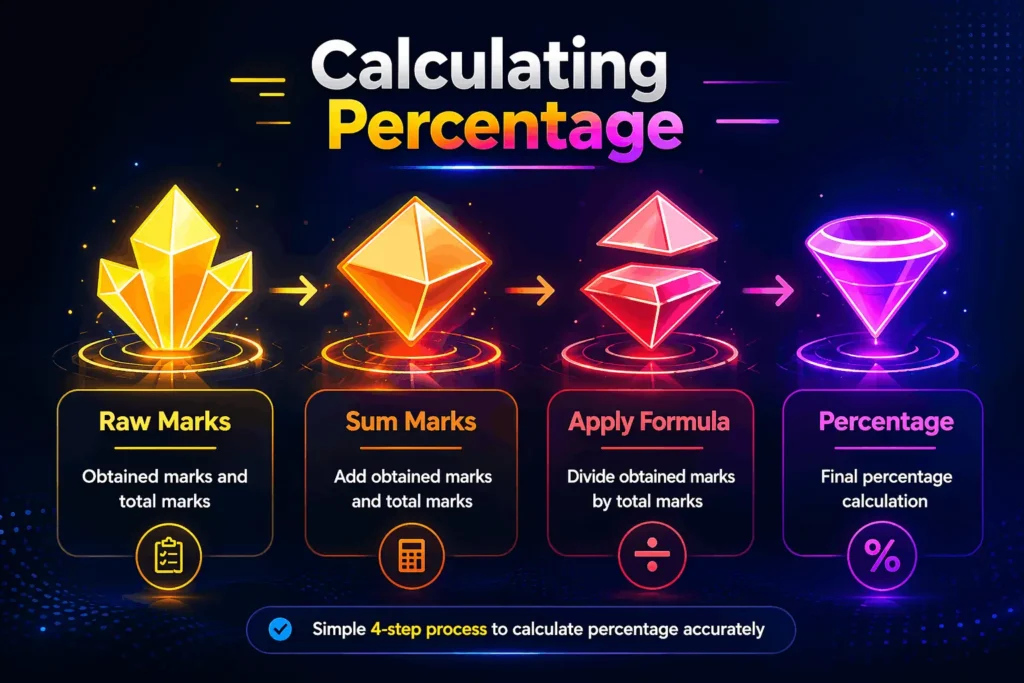
Calculate Percentage for Multiple Subjects
When you have marks from different subjects, calculating your overall percentage manually can feel confusing. But the process is actually very simple, and your percentage calculator can handle it instantly.
Step-by-Step Method
To calculate the percentage for multiple subjects, follow these steps:
- Add all your obtained marks
- Add all the total marks
- Divide the total obtained marks by the total marks
- Multiply the result by 100
Example (3 Subjects)
Let’s understand this with a clear example:
Marks obtained:
Step 1: Add obtained marks:
75 + 85 + 65 = 225
Step 2: Add total marks:
100 + 100 + 100 = 300
Step 3: Apply formula
225 ÷ 300 × 100 = 75%
✔ Final percentage = 75%
Example (Different Total Marks)
Marks obtained:
Step 1: Total obtained marks
40 + 70 + 45 = 155
Step 2: Total marks
50 + 100 + 75 = 225
Step 3: Calculation
155 ÷ 225 × 100 ≈ 68.89%
✔ Final percentage = 68.89%
Why This Method Matters
This method ensures:
Instead of calculating each subject separately, combining them gives a true overall result. Or simply convert your semester performance using our SGPA to CGPA calculator for a more accurate academic overview.
How to Calculate Average Percentage
Sometimes, you don’t just want a single result; you want to know your overall performance across multiple tests or exams. That’s where calculating the average percentage becomes important.
While a percentage calculator gives results in terms of marks, understanding averages helps you track long-term performance.
What is the average percentage?
Average percentage means the overall percentage calculated from multiple percentages or test scores.
It is commonly used for:
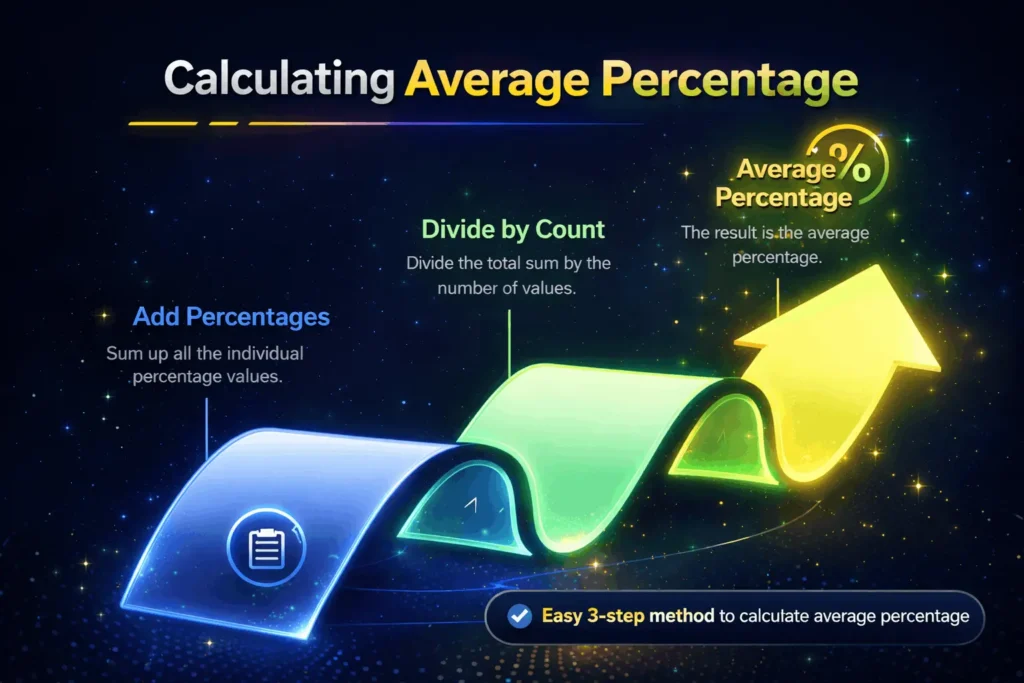
Method 1: Average of Percentages
If you already have percentages, use this method:
Add all the percentages.
Divide by the total number of values
Example:
Percentages:
Calculation:
(70 + 80 + 90) ÷ 3 = 80%
✔ Average percentage = 80%
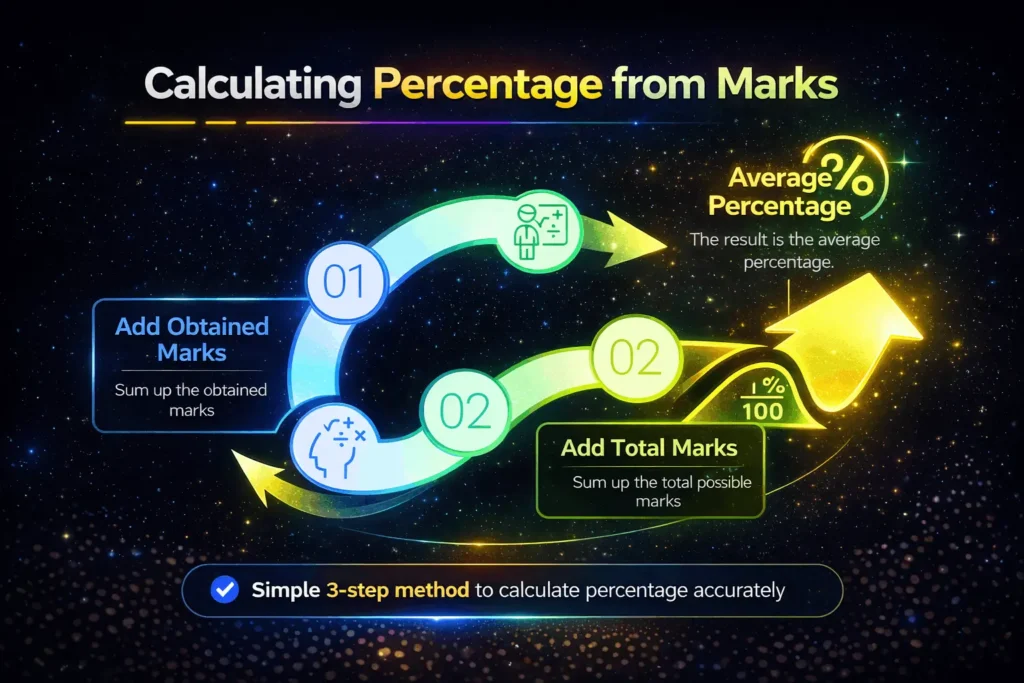
Method 2: From Marks (Accurate)
This is the recommended method because it gives the most accurate result.
Steps:
- Add all obtained marks
- Add all the total marks
- Apply the percentage formula
Example:
Marks:
Step 1: Total obtained marks
80 + 70 + 90 = 240
Step 2: Total marks
100 + 100 + 100 = 300
Step 3: Calculation
240 ÷ 300 × 100 = 80%
✔ Average percentage = 80%
Which Method Should You Use?
For quick results, you can always use a marks percentage calculator to avoid manual calculations. You can also convert overall performance using our Percentage to CGPA Calculator if your institution follows a CGPA system.
Pro Tip: If your subjects have different total marks, always use the marks-based method. It gives a more realistic and fair average.
Marks to Percentage for CBSE, IGCSE & IB
Different education boards use different grading systems, which can sometimes make it confusing to compare results. However, converting marks into percentages becomes easier when you understand how each system works.
Using a percentage calculator along with the correct method ensures accurate results across all major boards.
CBSE Marks to Percentage
In the CBSE system, percentage is usually calculated directly from marks:
Formula:
Percentage = (Total Marks Obtained ÷ Total Marks) × 100
✔ Example:
If you scored 450 out of 500:
450 ÷ 500 × 100 = 90%
✔ Final percentage = 90%
IGCSE / CIE Percentage System
In IGCSE (Cambridge) exams, results are often given as grades (A*, A, B, etc.), but they also correspond to percentage ranges.
Typical Conversion
Grade | Percentage Range |
A* | 90–100% |
A | 80–89% |
B | 70–79% |
C | 60–69% |
D | 50–59% |
✔ This helps students estimate their performance in percentage form.
IB (International Baccalaureate) Score System
The IB system uses a scale from 1 to 7 for each subject.
Approximate Conversion
IB Score | Percentage |
7 | 95–100% |
6 | 85–94% |
5 | 75–84% |
4 | 65–74% |
3 | 55–64% |
✔ Students typically take multiple subjects, and scores are combined to evaluate overall performance.
Why This Section Matters
Understanding these systems helps you:
This information is based on common academic grading practices used by major boards.
Importance of Percentage in Exams
Percentages are more than just numbers on a report card. They give a clear picture of your academic performance and help you understand where you stand compared to others.
Whether you use a percentage calculator or calculate manually, knowing your percentage plays an important role in your education journey.
Measure Your Performance
A percentage helps you evaluate how well you performed in an exam.
For example, scoring 75% in one test and 85% in another shows clear progress.
Set Academic Goals
When you know your percentage, you can set realistic goals for improvement.
Important for Admissions
Many schools, colleges, and universities use percentages as a key factor for:
A higher percentage can open better opportunities.
Track Long-Term Progress
By calculating percentages regularly, you can monitor your academic growth over time.
Real-Life Importance
Percentages are not limited to exams. They are used in:
So learning how to calculate percentages is a useful life skill.
Common Percentage Calculation Mistakes
Even though calculating a percentage looks simple, many students still make small mistakes that lead to wrong results. Whether you’re using a formula or a percentage calculator, avoiding these errors is important for accuracy.
Using Wrong Total Marks
One of the most common mistakes is entering incorrect total marks.
Example:
If your exam is out of 100, but you mistakenly use 90 as the total marks, your percentage will be completely wrong.
✔ Always double-check the maximum marks before calculating.
Forgetting to Multiply by 100
Some students divide the marks correctly but forget the final step.
Example:
80 ÷ 100 = 0.8 (NOT the final answer)
✔ Correct step:
0.8 × 100 = 80%
Mixing Different Subjects Incorrectly
When calculating percentages for multiple subjects, students sometimes
✔ Always:
Rounding Errors
Rounding too early can affect your final percentage.
Example:
68.89% → rounding to 69% before the final calculation can create slight inaccuracies.
✔ Keep decimals until the final result.
Using the Wrong Method for Average
Many students take the average of percentages instead of calculating from marks.
✔ Better approach:
Pro Tip:
To avoid all these mistakes, simply use a marks percentage calculator. It ensures:
Marks to Percentage Table Comparison
To make things even easier, here’s a quick reference table showing how marks convert into percentages. This helps you estimate your result without using a percentage calculator every time.
Marks vs Percentage (Out of 100)
Marks | Percentage |
10 / 100 | 10% |
20 / 100 | 20% |
30 / 100 | 30% |
40 / 100 | 40% |
50 / 100 | 50% |
60 / 100 | 60% |
70 / 100 | 70% |
80 / 100 | 80% |
90 / 100 | 90% |
100 / 100 | 100% |
Marks vs Percentage (Out of 200)
Marks | Percentage |
20 / 200 | 10% |
40 / 200 | 20% |
60 / 200 | 30% |
80 / 200 | 40% |
100 / 200 | 50% |
120 / 200 | 60% |
140 / 200 | 70% |
160 / 200 | 80% |
180 / 200 | 90% |
200 / 200 | 100% |
How to Use This Table
If your marks don’t exactly match the table, you can still use the formula or a marks percentage calculator for precise results.
Pro Tip: These tables are helpful for quick reference, but for exams with different total marks or multiple subjects, always calculate using the proper formula for accurate results.
Frequently Asked Questions
Conclusion
Calculating percentages is an essential skill for students, teachers, and anyone dealing with numbers. Whether you're working with single subjects, multiple exams, or overall performance, understanding how to calculate percentages helps you make better academic decisions.
While manual calculation is useful, using a percentage calculator saves time, reduces errors, and gives instant results. For a more comprehensive view of your academic performance, you can also use a final grade calculator to combine assignments, quizzes, and exam scores and get accurate results instantly. With the right formula, examples, and tips covered in this guide, you can now confidently calculate your marks and track your performance with ease.

About the Author
Mian Saqib Rasheed
Founder of GPA Converter Hub | Civil Engineering Graduate
Mian Saqib Rasheed is the founder of GPA Converter Hub and a civil engineering graduate. Inspired by challenges he faced while calculating GPA, CGPA, and academic percentages during university, he created this platform to help students access accurate educational calculators and resources.