
College GPA Calculator: Calculate Your Semester and Cumulative GPA Accurately
Enter your courses below and get your semester or cumulative GPA in seconds, plus a full guide on the 4.0 scale, grade point values, and how to raise your GPA before it's too late.
✅ Stop Guessing, Calculate Your GPA the Right Way

College GPA Calculator
Fill in all your courses — your results appear automatically once every field is complete.
GPA Scale Reference
What Is a College GPA Calculator?
A college GPA calculator is an academic tool that helps students calculate their grade point average (GPA) using course grades and credit hours. Students use it to measure academic performance, monitor progress toward graduation requirements, track scholarship eligibility, and understand their overall academic standing.
A GPA represents the average value of all grades earned during a semester or throughout a college program. Most colleges and universities use a 4.0 grading scale to evaluate student performance.
Whether you want to calculate a semester GPA or estimate a cumulative GPA, a college GPA calculator provides a quick and accurate way to determine your results.
Quick Answer: How Is College GPA Calculated?
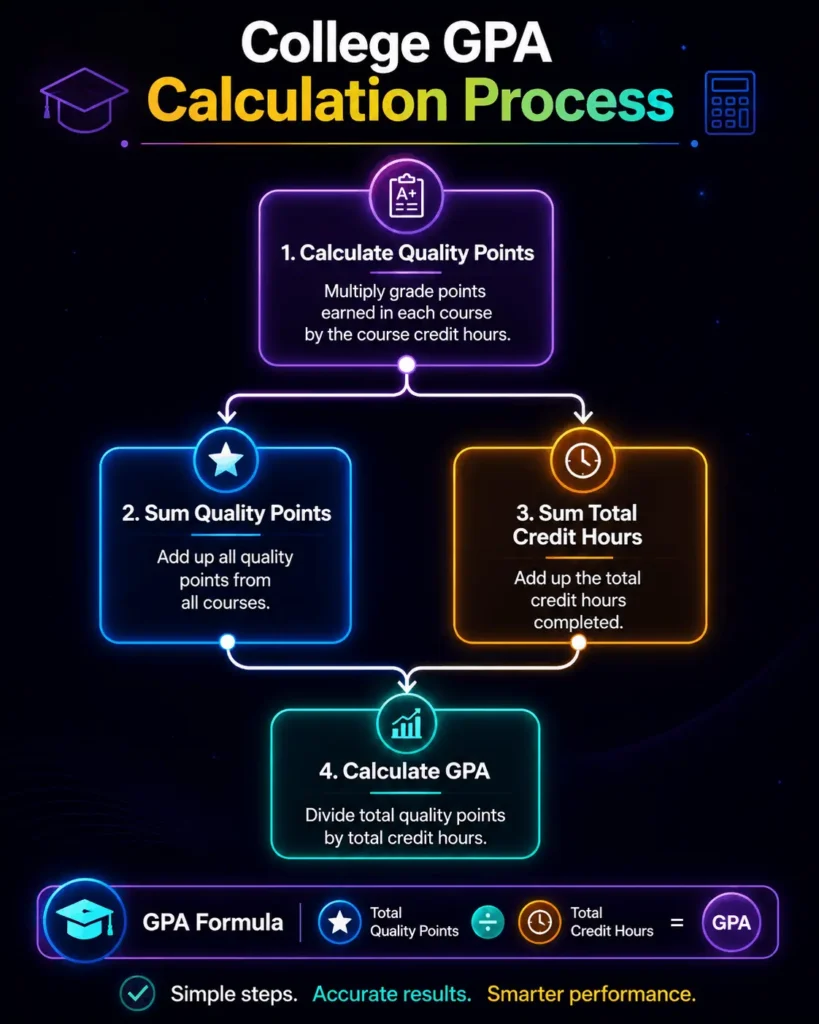
Use Our College GPA Calculator
Our College GPA calculator allows students to estimate their GPA within seconds.
Follow these simple steps:
- Enter each course you completed.
- Select the letter grade received for every course.
- Add the credit hours assigned to each course.
- Review all entered information.
- Click the calculate button to generate your GPA.
The calculator instantly processes the information and displays an accurate GPA based on standard college grading systems.
Students can use the tool after each semester to monitor academic progress and make informed decisions about future coursework.
Why Students Use a College GPA Calculator
Students regularly monitor their GPA because it affects several important academic opportunities.
A GPA can influence scholarship eligibility, academic honors, internship applications, graduate school admissions, and graduation requirements.
Many students calculate their GPA before meeting an academic advisor or reviewing their official transcript.
The calculator also helps students understand how individual course grades contribute to their cumulative academic performance.
Understanding GPA, CGPA, and Percentage
How to Calculate College GPA
A college GPA is calculated using two important factors:
Each letter grade corresponds to a specific grade point value.
For example:
Letter Grade | Grade Points |
A | 4.0 |
A- | 3.7 |
B+ | 3.3 |
B | 3.0 |
C+ | 2.3 |
C | 2.0 |
D | 1.0 |
F | 0.0 |
Each course also carries a certain number of credit hours.
Courses with more credit hours have a greater impact on the final GPA calculation.
College GPA Formula
GPA=\frac{\sum(Grade\ Points\times Credit\ Hours)}{Total\ Credit\ Hours}
This formula converts course performance into a single academic score.
The calculation uses quality points earned from each course and divides them by the total number of completed credit hours.
Understanding Quality Points
Quality points represent the weighted value of a grade after considering course credits.
For example, earning an A in a 4-credit course produces more quality points than earning an A in a 2-credit course.
Because of this weighting system, high-credit courses can significantly influence your GPA.
Understanding quality points helps students make better academic planning decisions throughout college.
College GPA Calculation Example
The example below demonstrates how a student can manually calculate their GPA.
Course | Grade | Credit Hours | Grade Points | Quality Points |
English Composition | A | 3 | 4.0 | 12.0 |
College Algebra | B+ | 4 | 3.3 | 13.2 |
Biology | A- | 4 | 3.7 | 14.8 |
Psychology | B | 3 | 3.0 | 9.0 |
History | A | 3 | 4.0 | 12.0 |
Step 1: Calculate Total Quality Points
12.0 + 13.2 + 14.8 + 9.0 + 12.0 = 61.0
Step 2: Calculate Total Credit Hours
3 + 4 + 4 + 3 + 3 = 17
Step 3: Apply the GPA Formula
61.0 ÷ 17 = 3.59
The student's GPA is 3.59.
This example shows how a strong performance in multiple courses contributes to a high grade point average.
Semester GPA vs Cumulative GPA
Students often confuse semester GPA with cumulative GPA.
Although both measurements evaluate academic performance, they serve different purposes.
Semester GPA
Cumulative GPA
Understanding the 4.0 GPA Scale
Most colleges and universities evaluate student performance using a 4.0 GPA scale.
Under this grading system, each letter grade corresponds to a numerical value. Higher grades produce more quality points and increase the overall grade point average.
The 4.0 scale remains the most widely used grading method across higher education institutions.
Letter Grade | GPA Value |
A | 4.0 |
A- | 3.7 |
B+ | 3.3 |
B | 3.0 |
B- | 2.7 |
C+ | 2.3 |
C | 2.0 |
C- | 1.7 |
D | 1.0 |
F | 0.0 |
Students should always verify grading policies through their registrar's office because some institutions use modified grading scales.
Weighted vs Unweighted GPA
Many students encounter both weighted and unweighted GPA systems during their academic journey.
An unweighted GPA follows the standard 4.0 scale regardless of course difficulty.
A weighted GPA assigns additional value to advanced, honors, or accelerated courses.
Most colleges calculate undergraduate academic standing using an unweighted GPA, although admissions offices may review both values during application evaluations.
What Is Considered a Good College GPA?
A good GPA depends on academic goals, scholarship requirements, and future educational plans.
Different universities and organizations evaluate GPA expectations differently.
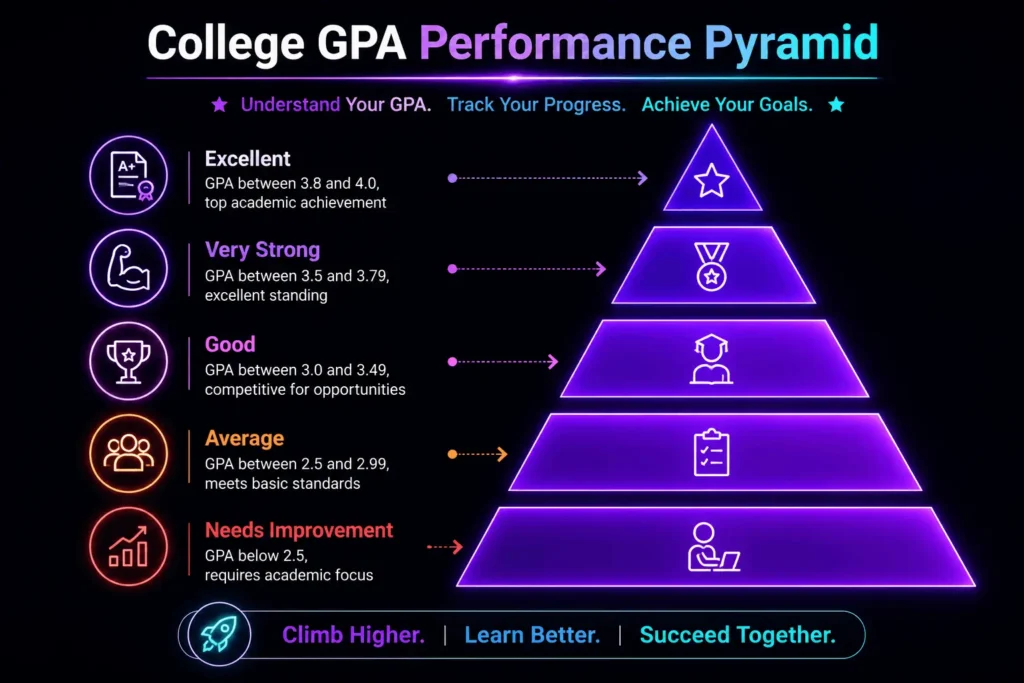
The table below provides a general benchmark used by many institutions.
GPA Range | Academic Performance |
3.8 – 4.0 | Excellent |
3.5 – 3.79 | Very Strong |
3.0 – 3.49 | Good |
2.5 – 2.99 | Average |
Below 2.5 | Needs Improvement |
A GPA above 3.0 generally keeps students competitive for many academic opportunities.
Students pursuing highly selective programs often target a GPA above 3.5.
Why Your College GPA Matters
A GPA serves as more than a numerical score.
It reflects academic consistency, course performance, and a student's ability to meet educational expectations.
Colleges, scholarship committees, and employers often use GPA as one factor when evaluating applications.
Understanding its importance helps students make informed academic decisions throughout their college experience.
Scholarships and Financial Aid
Many scholarship programs establish minimum GPA requirements before students become eligible for consideration.
Merit-based scholarships often reward students who maintain strong academic records across multiple semesters.
A higher GPA may increase access to institutional scholarships, private funding opportunities, and academic awards.
Students preparing scholarship applications often calculate their GPA before submitting transcripts and supporting documents.
Dean's List and Academic Honors
Many colleges recognize outstanding academic achievement through honors programs and Dean's List awards.
A Dean's List designation often requires a semester GPA above a specified threshold.
Although requirements vary by institution, maintaining a strong GPA improves eligibility for academic recognition.
These achievements may strengthen future scholarship and graduate school applications.
Academic Standing and Academic Probation
Colleges monitor student performance through academic standing policies.
Students who maintain acceptable GPA levels generally remain in good academic standing.
A significant GPA decline may place students on academic warning or academic probation.
Understanding GPA trends early allows students to seek support before academic difficulties become more serious.
Graduate School Admissions
Graduate programs frequently evaluate cumulative GPA during the admissions process.
Master's programs, MBA programs, and doctoral programs often establish minimum GPA requirements for applicants.
Admissions committees may also review GPA trends, major-specific coursework, and overall academic growth.
A strong GPA can strengthen an application and demonstrate consistent academic performance.
Medical School and Professional Programs
Professional programs typically maintain more competitive GPA expectations.
Medical schools, dental schools, pharmacy programs, and law schools often evaluate applicants using rigorous academic standards.
Students planning to enter these fields should monitor GPA performance throughout college rather than waiting until graduation.
Consistent academic achievement creates more opportunities during competitive admissions cycles.
Internships and Career Opportunities
Many internship programs review GPA when evaluating student candidates.
Competitive internships may use GPA requirements during the initial screening process.
Some graduate recruitment programs also consider academic performance when selecting applicants.
Although experience and skills remain important, maintaining a strong GPA can provide additional advantages early in a career.
GPA Requirements for Common Academic Goals
Students often ask how much GPA they need to achieve specific educational objectives.
The table below summarizes common GPA expectations across different goals.
Academic Goal | Typical GPA Range |
Good Academic Standing | 2.0+ |
Dean's List | 3.5+ |
Merit Scholarships | 3.0–3.8 |
Honors Programs | 3.5+ |
Graduate School Admission | 3.0+ |
MBA Programs | 3.0–3.7 |
Law School Admission | 3.5+ |
Medical School Admission | 3.7+ |
Requirements vary among institutions, so students should always verify official admission and scholarship criteria.
Tracking Academic Performance Across Multiple Tools
Common GPA Calculation Mistakes Students Make
Many students calculate GPA incorrectly because they overlook important details during the calculation process.
Understanding these common mistakes can help produce more accurate results and prevent academic misunderstandings.
Ignoring Credit Hours
Mixing Semester GPA and Cumulative GPA
Using Incorrect Grade Point Values
Forgetting Repeated Courses
Misunderstanding Transfer Credits
How to Improve Your College GPA
Improving GPA requires consistent academic effort rather than short-term adjustments.
Small improvements made throughout a semester often produce meaningful long-term results.
Students who actively monitor academic performance generally identify problems earlier and make better educational decisions.
Focus on High-Credit Courses
Set Semester GPA Goals
Use Academic Support Services
Meet With an Academic Advisor
Review Academic Progress Frequently
Additional Academic Tools That Can Help Students
Academic performance involves more than GPA calculations alone.
Students often use multiple grading tools throughout the semester to monitor progress and prepare for future assessments.
Before calculating GPA, many students determine overall exam performance using our Marks Percentage Calculator to convert obtained marks into percentages.
Frequently Asked Questions
Conclusion
A college GPA calculator provides a simple and accurate way to measure academic performance using course grades and credit hours. Regular GPA tracking helps students understand academic standing, monitor progress toward graduation requirements, and prepare for future educational opportunities.
Whether your goal involves scholarships, graduate school admissions, internships, academic honors, or long-term career planning, understanding GPA remains an important part of student success.
By combining GPA calculations with tools such as CGPA conversions, percentage calculators, semester grade evaluations, and final grade planning resources, students can develop a clearer understanding of their academic journey and make informed decisions throughout college.

About the Author
Mian Saqib Rasheed
Founder of GPA Converter Hub | Civil Engineering Graduate
Mian Saqib Rasheed is the founder of GPA Converter Hub and a civil engineering graduate. Inspired by challenges he faced while calculating GPA, CGPA, and academic percentages during university, he created this platform to help students access accurate educational calculators and resources.