
SGPA to CGPA Calculator – Convert with 100% accuracy and quick Results (2026)
Convert SGPA to CGPA using the standard grading formulas followed by Indian universities.
✅ Free, accurate, and based on Indian university standards

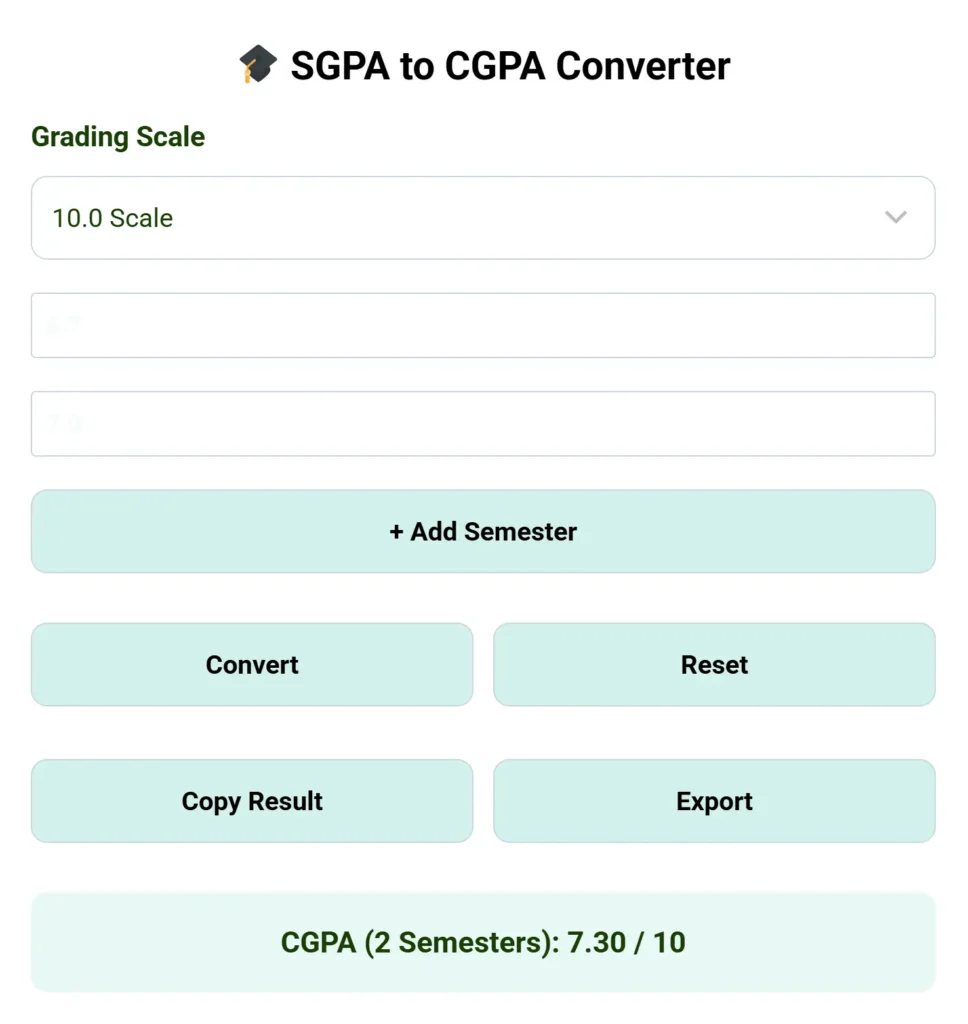
🎓 SGPA to CGPA Converter
Getting confused about how your semester scores add up? You're not alone. Thousands of students struggle to understand their overall academic standing.
This SGPA to CGPA calculator solves that problem in 10 seconds. Enter your semester grades and get your cumulative score instantly, or use our GPA calculator tool for more detailed academic analysis.
This SGPA to CGPA calculator solves that problem in 10 seconds. Enter your semester grades. Get your cumulative score. No complex formulas needed.
What is an SGPA to CGPA Calculator & Why Do You Need It?
This tool converts semester scores into your overall academic record.
Think of it like this: each semester is one chapter. Your final grade is the whole book.
Why does this matter?
Companies check your cumulative score during placements. Universities need it for admissions. Scholarship committees review it for funding decisions.
A 7.8 semester score looks different from a 7.8 overall score. The difference affects your career options. Most students calculate incorrectly. They forget about credit hours. They round numbers too early. They mix different grading systems. This calculator prevents those mistakes.
According to the University Grants Commission (UGC), Indian universities follow standardised grading systems. But each institution has slight variations. Knowing your accurate score helps you plan better.
What do you get?
No registration required. No hidden fees. Just accurate numbers.
What does your SGPA mean?
Your SGPA isn't just a number; it determines placement eligibility, scholarship criteria, and graduate school admissions. Here's what each range means in the Indian university system:
SGPA range | Percentage (approx.) | Classification | What it means |
9.0 – 10.0 | 82.5% – 92.5% | Outstanding | Top-tier placements, IIT/IIM eligible, most scholarships |
8.0 – 8.9 | 72.5% – 82.4% | Excellent | Good for top MNCs (TCS, Infosys, Wipro); eligible for most PSUs |
7.0 – 7.9 | 62.5% – 72.4% | Good | Meets most placement cutoffs (7.0 CGPA is the common threshold) |
6.0 – 6.9 | 52.5% – 62.4% | Average | Eligible for placements but may be screened out at the shortlisting stage |
Below 6.0 | Below 52.5% | Need improvement | Restricted placement access; focus on improving next semester SGPA |
Most Indian companies use a 7.0 CGPA cutoff. If your SGPA is currently below 7.0, use our calculator above to find exactly what SGPA you need in the remaining semesters to cross the threshold.
How to calculate CGPA from SGPA across all semesters
CGPA is the simple average of all your semester SGPAs. The formula is the same whether you have 2 semesters or 8.
CGPA = (SGPA₁ + SGPA₂ + … + SGPAₙ) ÷ n
Where n = total number of semesters completed.
Step-by-step for 6 semesters.
- Note your SGPA for each semester (e.g., 7.8, 8.1, 7.5, 8.4, 8.0, 7.9)
- Add all SGP As together: 7.8 + 8.1 + 7.5 + 8.4 + 8.0 + 7.9 = 47.7
- Divide by the number of semesters: 47.7 ÷ 6 = 7.95
- Your CGPA after 6 semesters = 7.95
Worked Example – 8th Semester
Semester 1 | 7.6 |
Semester 2 | 8.0 |
Semester 3 | 7.8 |
Semester 4 | 8.3 |
Semester 5 | 8.1 |
Semester 6 | 7.9 |
Semester 7 | 8.4 |
Semester 8 | 8.2 |
Sum | 64.3 |
CGPA (÷ 8) | 8.04 |
Understanding SGPA to CGPA Calculator—The Complete Difference
There is a clear difference between SGPA and CGPA, which needs to be differentiated to know which to consider important and which a student should focus on.
What is SGPA (Semester Grade Point Average)?
SGPA measures your performance for one term. You take five courses in a semester. Each course has assignments, exams, and projects. Your scores combine into one number for that period.
For example:
You scored 8.5 in Semester 1. That's your SGPA range for those four months.
This number tells you how you performed during that specific term. It doesn't show your overall journey. Universities calculate SGPA at the end of each semester. Students receive it with their grade sheets. Parents see it on report cards.
What is CGPA (Cumulative Grade Point Average)?
CGPA shows your performance across all completed semesters.
Your first semester: 7.8. Your second semester: 8.2. Your third semester: 8.0. CGPA combines all three into one score. This number appears on your final transcript. Employers see this when you apply for jobs. Universities check this for master's programmes.
Real Scenario:
Rahul has four semesters done. His scores are 7.5, 8.0, 8.2, and 8.5. His CGPA is 8.05. Companies don't ask for semester scores. They want cumulative performance. That's what CGPA provides.
Key Differences at a Glance
Average | SGPA | CGPA |
Time Period | One Semester | All Semesters |
Updates | Every 4-6 Months | After each term |
Show us | Semester Mark sheets | Final transcripts |
Used for | Term tracking | Job applications |
Calculation | Single-term courses | All completed courses |
SGPA is a snapshot. CGPA is the full picture. Students track SGPA to monitor progress. They improve the CGPA, which leads to better opportunities.
How to Calculate CGPA from SGPA—Two Simple Methods
Method 1: Individual Semester Calculation (Highly Recommended)
This method works when you know each semester's score separately.
Step 1: List all your semester scores.
Step 2: Add all scores together.
Step 3: Divide by the total semesters.
The Formula:
CGPA = (SGPA₁ + SGPA₂ + SGPA₃ + ... + SGPAₙ) ÷ Total Semesters.
Real Example:
Priya completed three semesters:
Sum: 7.8 + 8.2 + 8.5 = 24.5
CGPA: 24.5 ÷ 3 = 8.17
Her overall score is 8.17. This qualifies her for most company placements.
Method 2: Total SGPA Sum (Quick Method)
Use this when you already know your total.
Some mark sheets show the sum of all semesters. This saves you additional time.
Step 1:
Step 2:
Step 3:
The Formula:
CGPA = Total SGPA Sum ÷ Total Number of Semesters.
Real Example:
Arjun has completed six semesters. His total semester score is 48.6
CGPA: 48.6 ÷ 6 = 8.10.
He has an 8.10 cumulative score. This opens doors to top recruiters.
Which method should you use?
Both give the same result. Choose what's easier for your data.
How Do I Convert SGPA to CGPA?
This is the most common question students ask.
The short answer: Add all semester scores and divide by the number of semesters. But there's more to it.
For equal credit systems
Take all your semester scores. Add them up. Divide by how many semesters you completed. That's your answer.
For different credit systems
Some semesters have more credits than others. A semester with 24 credits counts more than one with 20 credits. You'll need the weighted method for this. We'll cover that in the next section.
Quick check
Do all your semesters have the same number of credits?
Yes? Use simple averaging.
No? Use weighted calculations.
Most undergraduate programmes in India use equal credits. Engineering programmes often use weighted systems.
Check your university's credit structure. It's usually mentioned in your handbook or on the registrar's website. Moreover, you can convert CGPA to Percentage for further results
SGPA to CGPA Calculator for Credit-Based Systems (Advanced)
The SGPA to CGPA calculator should be calculated only on the advanced credit-based system according to Indian universities.
Understanding Credit Hours and Weighted Calculation
Not all semesters are equal.
Your first semester might have 20 credit hours. Your third semester might have 24 credit hours. The semester with more credits should count more in your final score.
What are credit hours?
Credits measure course difficulty and time commitment. A 4-credit course needs more work than a 2-credit course.
Most Indian engineering colleges follow the Choice-Based Credit System (CBCS). This system assigns different credits to different courses.
Why do credits matter?
Step-by-Step Credit-Based Calculation
The weighted formula for CGPA is
CGPA = (SGPA₁ × Credits₁ + SGPA₂ × Credits₂ + ...) ÷ Total Credits
Detailed Example:
Meera is in her third semester. Here's her record:
Semester | SGPA | Credits | Weighted Score |
Semester 1 | 8.0 | 20 | 160 |
Semester 2 | 8.5 | 22 | 187 |
Semester 3 | 9.0 | 24 | 216 |
Total | - | 66 | 563 |
Step 1: Multiply each SGPA by its credits.
- Sem 1: 8.0 × 20 = 160
- Sem 2: 8.5 × 22 = 187
- Sem 3: 9.0 × 24 = 216
Step 2: Add all weighted scores: 160 + 187 + 216 = 563.
Step 3: Add all credits: 20 + 22 + 24 = 66.
Step 4: Divide the weighted total by the total credits: 563 ÷ 66 = 8.53.
Meera's weighted CGPA is 8.53.
If she used simple averaging: (8.0 + 8.5 + 9.0) ÷ 3 = 8.50
The difference is small but matters for competitive placements. Some companies have 8.5 cut-offs. That 0.03 could make the difference.
Where to find your credit information
Check your semester GPA or grade sheet. Credits appear next to each course. Your university website has the credit structure. Your department handbook lists credits per semester.
What is the CGPA of a 7.5 SGPA?
This question confuses many students.
Here's the truth: a single-semester score doesn't equal CGPA.
If 7.5 is your score for one semester:
You need other semester scores to calculate the CGPA. One semester alone doesn't give you a cumulative score.
Example scenario:
You scored 7.5 in Semester 1. Your other semesters are:
- Semester 2: 7.8
- Semester 3: 8.0
- Semester 4: 7.9
CGPA: (7.5 + 7.8 + 8.0 + 7.9) ÷ 4 = 7.80.
Your cumulative score is 7.80, not 7.5.
If you maintain 7.5 in all semesters:
Then your CGPA would be 7.5. But most students' scores vary across semesters.
What does 7.5 mean?
In percentage terms: 7.5 × 9.5 = 71.25%
This meets the minimum requirements for most Indian companies. TCS and Infosys accept students with 6.0+ CGPA.
What is 9.5 SGPA?
A 9.5-semester score is excellent.
This puts you in the top 5% of students. Most students score between 6.5 and 8.5.
As a percentage:
9.5 × 9.5 = 90.25%
That's the distinction level in most universities.
If maintained across all semesters:
Six semesters with 9.5 each = 9.5 CGPA
This score opens doors to:
- Top tech companies (Google, Microsoft, Amazon)
- Premium business schools
- Foreign university scholarships
- Research positions
Real impact:
Companies like Amazon prefer 8.0+ CGPA. Google and Microsoft look for 8.5+ scores. A 9.5 CGPA makes you highly competitive.
But remember: one semester at 9.5 is great. Maintaining it across all semesters is the real challenge.
University-Specific SGPA to CGPA Formula
Different universities use different calculation methods.
VTU (Visvesvaraya Technological University)
VTU follows a credit-based system. Each course has different credits. Students multiply SGPA by course credits. Then divide by total credits. This gives the weighted average. The university updated its grading system in 2015. All students now follow the CBCS guidelines.
Anna University
Anna University uses a 10-point grading scale. Most courses are equivalent in credits per semester. Students can use simple averaging for most programs. Engineering students should check their specific branch credits. The university provides grade conversion tables in student handbooks.
Mumbai University
Mumbai University follows a semester and credit-based system. Each semester has a fixed credit structure. Most undergraduate programs have 20 credits per semester. Some professional courses have variable credits. Students should refer to their course structure document for details. This lists credits for each semester.
Delhi University
DU implemented CBCS in 2015. Different courses have different credits. Core courses carry more credits than electives. Students need a weighted calculation for an accurate CGPA. The university's examination portal shows credit details for each course.
JNTU (Jawaharlal Nehru Technological University)
JNTU uses a complex credit system. Credits vary by course type and year. Foundation courses: 3-4 credits. Core subjects: 4-5 credits. Lab courses: 1-2 credits. Students should check their specific campus guidelines. JNTU has multiple campuses with slight variations.
GTU (Gujarat Technological University)
GTU follows standard CBCS norms. Semester credits range from 20 to 28. Theory courses: 4 credits, Practical courses: 2 credits, Projects: 4-8 credits. The university website has a CGPA calculator. Students can verify their calculations there.
KTU (Kerala Technological University)
KTU implemented uniform credit distribution in 2019. Most semesters now have equal credits. Students can use simple averaging for recent batches. Older batches should check their year-specific structure.
IP University (Guru Gobind Singh Indraprastha University)
IP University uses semester-wise credit distribution. Engineering programs have 20-24 credits per semester. The university follows UGC guidelines strictly. Students receive detailed credit information with each semester's results.
Finding your university's method:
Check your student handbook. Visit the examination section of your university website. Ask your department's academic coordinator. Look at your grade sheet for credit information.
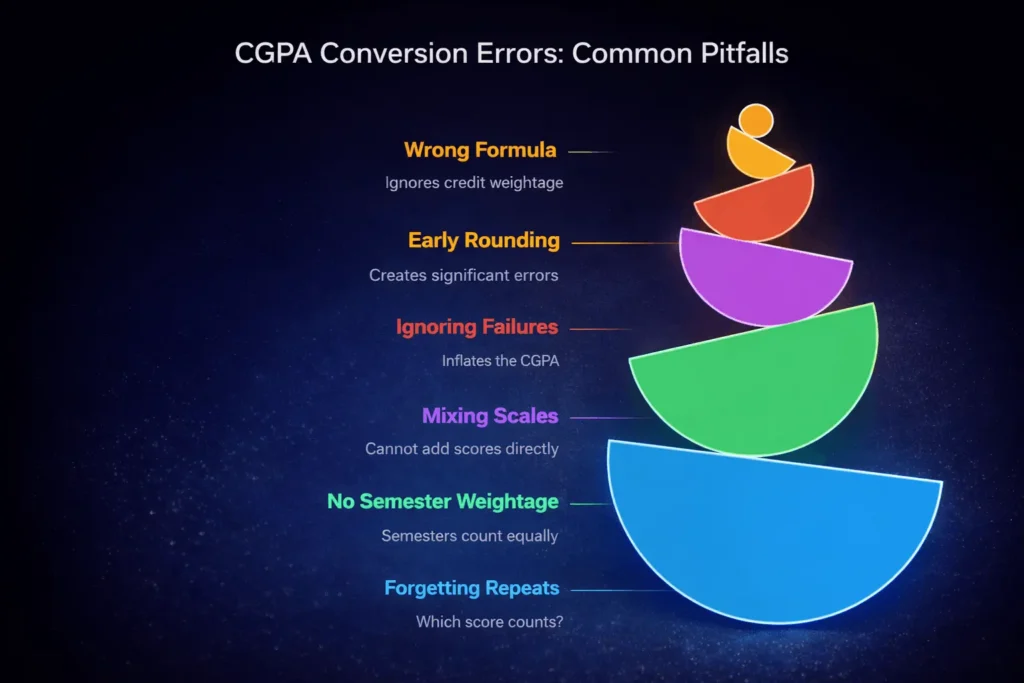
Common Mistakes When Converting SGPA to CGPA
A lot of students make huge mistakes while converting SGPA to CGPA, which, in the end, gives them a CGPA that is not correct, and then they face different consequences.
Using the Wrong Conversion Formula
Rounding Numbers Too Early
Ignoring Failed Subjects and Backlogs
Mixing Different Grading Scales
Not Understanding Semester Weightage
Forgetting to Update for Repeated Courses
If replacement policy: Use 7.0 in CGPA calculation
If averaging policy: Use (4.0 + 7.0) ÷ 2 = 5.5
If best score policy: Use 7.0 (the higher one)
Since these policies can affect your overall academic performance, you can also use a final grade calculator to combine your updated scores and get a more accurate final result.
Check your university handbook. The rules are usually in the "Re-examination" or "Grade Improvement" section.
Real Student Scenarios – SGPA to CGPA Calculator Examples
Now let's talk about different field students and how they calculate their CGPA from their SGPA. Everything is to be discussed in detail.
Engineering Student with Varying Credit Hours
Meet Karthik:
He's in his fourth year of B.Tech. Computer science. His university uses CBCS with variable credits.
His complete record
Semester | SGPA | Credits | Calculation |
1 | 7.2 | 20 | 7.2 × 20 = 144 |
2 | 7.5 | 20 | 7.5 × 20 = 150 |
3 | 7.8 | 22 | 7.8 × 22 = 171.6 |
4 | 8.0 | 22 | 8.0 × 22 = 176 |
5 | 8.2 | 24 | 8.2 × 24 = 196.8 |
6 | 8.5 | 24 | 8.5 × 24 = 204 |
7 | 8.8 | 26 | 8.8 × 26 = 228.8 |
8 | 9.0 | 28 | 9.0 × 28 = 252 |
Total | - | 186 | 1523.2 |
Calculation:
Total weighted SGPA: 1523.2. Total credits: 186.
CGPA: 1523.2 ÷ 186 = 8.19.
Key observation:
His placement outcome:
With an 8.19 CGPA, Karthik qualified for Accenture, Wipro, and TCS. He missed Amazon's 8.5 cut-off by 0.31 points.
Commerce Student with Failed Subject
Meet Priya:
She's pursuing a B.Com from Mumbai University. She failed one subject in semester 2.
Her journey
How her CGPA changed:
After clearing the backlog:
Lesson learned:
Her advice:
Student Aiming for MS Abroad
Meet Arjun:
He wants to pursue an MS in computer science from a US university. He needs to convert his Indian CGPA to the American 4-point GPA scale.
His Indian scores:
Semester | SGPA (10 Points) |
1 | 8.0 |
2 | 8.3 |
3 | 8.5 |
4 | 8.7 |
5 | 8.9 |
6 | 9.0 |
7 | 9.2 |
8 | 9.4 |
Indian CGPA: (8.0 + 8.3 + 8.5 + 8.7 + 8.9 + 9.0 + 9.2 + 9.4) ÷ 8 = 8.75
Converting to a 4-point scale:
Common formula: Divide by 2.5
8.75 ÷ 2.5 = 3.50 GPA
But there's more: different evaluation services use different methods. WES (World Education Services) might calculate differently from ECE (Educational Credential Evaluators).
WES conversion:
Arjun's strategy:
Universities he qualified for:
Most US universities want a 3.0+ GPA for MS programmes. Top universities prefer 3.5+. Arjun's 3.48 made him competitive for:
He missed Stanford's and MIT's usual 3.7+ preference.
Important note:
Always check specific university requirements. Some accept the Indian percentage directly. Others need an official evaluation. Budget $200-300 for credential evaluation services.
How much is 70% in SGPA?
Converting a percentage to SGPA is simple.
The standard formula:
SGPA = Percentage ÷ 9.5
For 70%:
70 ÷ 9.5 = 7.37 SGPA
Most universities round this to 7.4.
What does a 7.4 SGPA mean?
This is a good score. It meets the minimum requirements for most companies.
Company eligibility with 7.4:
You qualify for mass recruitment. You might miss product-based companies that prefer 8.0+.
For higher education:
Alternative formula:
Why Your CGPA Matters – Career & Education Impact
A student's CGPA matters a lot in their educational and professional careers. Now the question is, how does it matter? Let's see!
Minimum CGPA Requirements for Top Companies
Your CGPA is the first filter in placements.
Mass Recruiters (High-volume hiring):
Company | Minimum | CGPA Percentage |
TCS | 6.0 | 60% |
Infosys | 6.5 | 65% |
Wipro | 6.0 | 60% |
Cognizant | 6.5 | 65% |
Tech Mahindra | 6.0 | 60% |
HCL | 6.5 | 65% |
These companies hire in large numbers. Meeting the cut-off gets you to the interview stage.
Product-Based Companies (Selective Hiring):
Company | Preferred CGPA | Reality |
Amazon | 7.5+ | Most hires have 8.0+ |
Microsoft | 8.0+ | The average is 8.5+ |
8.5+ | Most have 9.0+ | |
Adobe | 8.0+ | Strong preference for 8.5+ |
Nvidia | 8.0+ | Technical skills matter more |
Higher CGPA increases your chances. But these companies also value projects, internships, and coding skills.
Start-ups and Core Companies
Startups often have flexible cut-offs. They care more about skills and enthusiasm. Core engineering companies (manufacturing, construction) usually want 6.5 to 7.0.
Reality check:
A 9.5 CGPA doesn't guarantee a job. A 6.5 CGPA doesn't disqualify you. Companies look at the complete profile. But CGPA gets you through the first door.
CGPA for Higher Education & Study Abroad
Now, anyone who wants to study abroad for higher education should know what CGPA is required.
Master's programs in India
Most universities want a minimum of 6.5 to 7.0. Premier institutes like IITs and IIMs prefer 8.0+.
For MBA programmes:
Study abroad requirements
United States:
Canada:
United Kingdom:
Germany:
Australia:
These are general guidelines. Each university sets its own standards. Always check specific programme requirements.
Scholarship Eligibility Based on CGPA
Now, the eligibility for the scholarship based on CGPA is as follows:
Government scholarships
Most Indian government scholarships require a CGPA of 7.5+. Some examples:
University merit scholarships
Private universities often give merit scholarships:
International scholarships
Foreign universities offer scholarships based on academic merit:
Corporate scholarships
Many companies sponsor education:
A strong CGPA opens more funding opportunities. This reduces education costs significantly.
How to Improve Your CGPA in the Remaining Semesters
Calculate what you need:
Let's say you have a 7.0 CGPA after four semesters. You want to reach 7.5 by graduation (eight semesters total).
Current situation: Four semesters done with a 7.0 average. Total semester score so far: 7.0 × 4 = 28.0
Target: Eight semesters with a 7.5 average. Total semester score needed: 7.5 × 8 = 60.0
What you need in the remaining semesters: 60.0 - 28.0 = 32.0 (across four semesters). 32.0 ÷ 4 = 8.0 per semester
You need an 8.0 SGPA in each remaining semester.
Is this realistic?
If you scored 7.0 consistently, jumping to 8.0 requires significant improvement. But it's achievable with focused effort.
Practical Tips to Boost Your Grades
The following are a few important and practical tips to boost your current Grades in the semester.
Focus on high-credit subjects
Not all courses carry equal weight. A 4-credit course impacts your SGPA more than a 2-credit course.
Identify high-credit subjects each semester. Allocate more study time there. Even small improvements in heavy courses make big differences.
Clear backlogs immediately
Every failed course sitting on your record pulls your CGPA down. Clear them in the next available exam.
Don't wait for the final year. Clearing backlogs early gives you more semesters to improve.
Improve attendance
Many universities award marks for attendance. Some give up to 5% of total marks.
Good attendance = More internal marks = Better SGPA
Take advantage of internal assessments
Internal marks often contribute 30-40% to final grades. These are easier to score well in.
Participate in class. Complete assignments on time. Do well in mid-term exams. These build a cushion for final exams.
Choose electives wisely
Select electives where you can score well. Research with seniors about easy-scoring electives.
A high score in an elective boosts your semester average.
Form study groups
Studying with focused peers improves understanding. Teaching others reinforces your own knowledge.
Choose group members who are serious about grades.
Use previous year papers
Many exam questions repeat patterns. Solving previous papers helps you understand what examiners expect.
Universities often have similar question structures.
Time your improvement
Later semesters often have higher credits. Improving in the final years has more impact on CGPA.
But don't neglect early semesters. Building a strong base helps you understand advanced concepts.
Reality of improvement
Jumping from 6.0 to 9.0 is nearly impossible. But 6.0 to 7.0 is very achievable. Set realistic targets.
Small, consistent improvements compound over semesters.
Should I compromise on CGPA in the first year?
Short answer: No.
Many students think the first year doesn't matter. This is a costly mistake.
Why does the first-year CGPA matter?
Here are some important factors that need to be considered for the first-year CGPA.
Sets your baseline
Hard to recover later
Placement implications
Scholarship impact
Mind-set effect
The recovery reality
Better strategy
But what if you already have a low first-year CGPA?
Don't panic. Focus on improving each semester. Show an upward trend. Many companies value improvement over absolute numbers.
A 6.5 to 8.0 journey impresses more than a flat 7.5.
Common Student Concerns – Real Talk
Let's be honest about score ranges.
9.0-10.0 SGPA: Top 5% territory
You're among the best. Dream companies are within reach. But don't get complacent. Companies also check technical skills and projects.
This range qualifies you for nearly everything. Top placements. Foreign scholarships. Research positions.
8.0-8.9 SGPA: Top 20% range
Strong performance. You qualify for most good opportunities. Product companies interview you. Good universities abroad accept you.
Keep up this performance. One weak semester can drop you to 7s.
7.0-7.9 SGPA: Solid middle ground
This is where most students land. You meet cut-offs for mass recruiters. You qualify for most master's programs.
Not the top tier, but respectable. Focus on skills and projects to stand out.
6.0-6.9 SGPA: Minimum acceptable zone
You have clear basic cut-offs. But competition is tough. Many students have similar scores.
Your projects, internships, and skills matter more here. Use them to differentiate yourself.
Below 6.0 SGPA: Needs immediate attention
Most companies filter you out automatically. This limits placement options significantly.
Focus intensely on improvement. Consider additional certifications. Build strong skills. Some companies value abilities over grades.
Where do you stand?
Check your current average. Be realistic about your range. Understand what opportunities fit your profile.
Then work on either maintaining or improving your position.
What Students Ask on Forums
"Can I get into IIT for M.Tech with a 7.2 CGPA?"
It depends on the GATE score and the interview. IITs consider the overall profile. A good GATE score compensates for an average CGPA.
But you'll face tough competition from 8.5+ students.
"Will Google hire me with a 7.8 CGPA?"
Google can hire you if you ace their technical rounds. CGPA gets you the interview. Performance in interviews gets you the job.
Their coding rounds matter more than grades. But getting that interview call is easier with 8.0+.
"Should I focus on CGPA or projects?"
False choice. You need both. CGPA gets you past filters. Projects get you through interviews.
Maintain a decent CGPA (7.0+). Simultaneously build strong projects. This combination works best.
"Can I hide my CGPA on my resume?"
Don't try this. Background verification catches it. Honesty matters.
If your CGPA is low, highlight other strengths. Show projects, internships, and certifications. Address it if asked.
Some companies specifically ask for transcripts. Hiding information ruins trust.
Difference between SGPA and CGPA – Complete Breakdown
SGPA looks at one semester. You take 5-6 courses. The score reflects those specific subjects.
CGPA covers all semesters. It combines every course you've taken. This gives a broader view.
Example:
Rahul took Data Structures in semester 3. He scored excellent marks. His Semester 3 SGPA was high.
But his overall CGPA also includes semesters 1 and 2, where he scored lower. The cumulative picture is different from a single semester.
Update Frequency
SGPA updates every semester. You get a new SGPA after each term.
CGPA updates too, but it's cumulative. It carries forward all previous performance.
Pattern:
Semester 1 ends: You have SGPA for Sem 1, CGPA after Sem. 1. Semester 2 ends: You have SGPA for Sem 2, CGPA after Sem 2, etc. Your latest CGPA always includes all completed semesters.
Documentation Differences
SGPA appears on semester mark sheets. Each term's grade card shows that period's SGPA.
CGPA appears on your final consolidated transcript. Degree certificates mention cumulative performance.
What do employers see?
During placements, you often submit semester-wise mark sheets. These show individual SGPAs.
For final offer letters, companies ask for consolidated transcripts. These show CGPA. Both matter at different stages.
Usage in Applications
For semester tracking: Use SGPA to monitor progress. It tells you how you're doing each term.
For final evaluation: Use CGPA for job applications. For university admissions. For scholarship applications.
Most forms ask for CGPA, not individual semester scores.
Impact on Opportunities
A single bad SGPA can be recovered. You have remaining semesters to improve. This pulls your CGPA back up.
A bad CGPA is harder to fix. It represents sustained performance across multiple terms.
Recovery timeline
A bad SGPA in one semester: 3-4 more semesters can significantly improve CGPA. Bad CGPA overall: Requires exceptional performance in all remaining semesters
This is why consistent performance beats sporadic excellence.
Calculation Methods
SGPA calculation:
- Sum all course grade points in that semester
- Divide by the number of courses (or total credits)
- The result is the semester's SGPA
CGPA calculation:
- Sum all semester SGPAs (or use weighted method with credits)
- Divide by the total number of semesters (or total credits)
- The result is cumulative CGPA
Both use grade points. But CGPA adds an extra aggregation step.
Frequently Asked Questions (FAQs)
Final Summary – Master Your CGPA Calculation
Converting semester scores to cumulative performance is straightforward when you know the right method. SGPA measures one term. CGPA measures all terms combined. Simple averaging works when all semesters have equal credits. Weighted calculation is needed when credits vary.
Check your university's specific formula. Different institutions have different rules. Don't mix grading scales from different systems. Maintain a 7.5+ CGPA for good placement options. Aim for 8.0+ for premium companies. Build skills alongside maintaining grades.
Most programmes need 7.0+ minimum. Top universities prefer 8.5+. Consider both CGPA and entrance exam scores. Use this calculator to verify your calculations, and also you can convert a percentage to CGPA if required. Don't round numbers until the final result. Include all semesters, including those with backlogs.
Calculate your current CGPA now. Identify what you need in the remaining semesters. Plan your study strategy accordingly. Your CGPA opens doors. But your skills and knowledge determine success. Focus on both.
Remember: Grades matter. But they're not everything. Companies hire capable people, not just high CGPAs. Build a complete profile. Start calculating now. Know where you stand. Plan where you want to go.

About the Author
Mian Saqib Rasheed
Founder of GPA Converter Hub | Civil Engineering Graduate
Mian Saqib Rasheed is the founder of GPA Converter Hub and a civil engineering graduate. Inspired by challenges he faced while calculating GPA, CGPA, and academic percentages during university, he created this platform to help students access accurate educational calculators and resources.