
SGPA to Percentage Calculator – Instant Conversion for All Universities
This SGPA to Percentage Calculator helps students accurately convert grades using widely accepted academic methods.
✅ Simple SGPA to Percentage Conversion You Can Rely On
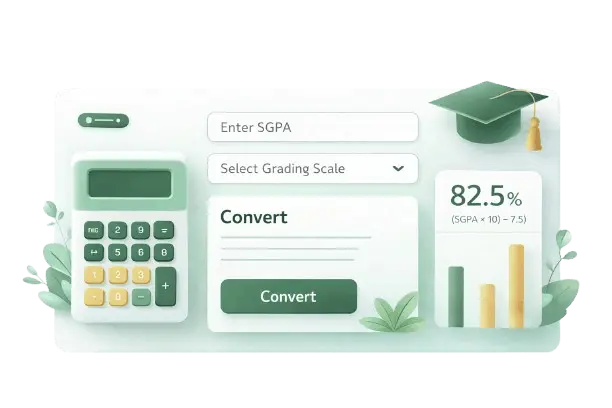
🎓 SGPA to Percentage Converter
🎓 Grade Calculator
Converting SGPA to percentage is simple. Multiply your SGPA by 10, then subtract 7.5. An 8.0 SGPA equals 72.5%.
Most job applications at TCS, Infosys, and Wipro need a percentage, not an SGPA. University admissions for higher studies also require a percentage format. Knowing your exact percentage matters for checking placement eligibility.
Our calculator does this instantly. No manual calculations needed. Use the calculator above to convert your SGPA in under 5 seconds.
Quick Answer – SGPA to Percentage Formula
Formula: Percentage = (SGPA × 10) – 7.5
Examples:
Some universities, like VTU, use different formulas. We cover those below.
What is SGPA, and Why Does It Matter?
SGPA stands for Semester Grade Point Average. It shows your academic performance for one semester. Most Indian universities calculate SGPA using credit hours and grade points. Each course has assigned credits. Your grades in those courses determine your grade points. SGPA is the average of all these calculations. CGPA is different. CGPA covers all semesters combined. SGPA focuses on just one semester. Think of SGPA as your semester report card. CGPA is your overall degree performance.
Why do students need percentage conversion? Three main reasons.
Your SGPA alone won’t work for these opportunities. Percentage conversion is necessary. It helps you check eligibility quickly. You can plan your applications better.
How to convert SGPA in Percentage
Converting SGPA to percentage takes three simple steps.
Using Our Calculator (Easiest Method)
The calculator saves your results automatically. You can convert multiple SGPAs at once. Print or download the results table for future reference.
Manual Calculation Method
You can also calculate without the tool. Use this formula: (SGPA × 10) – 7.5.
Common Conversion Mistakes
Students make three frequent errors.
First mistake: Using the wrong formula. VTU students often use the standard formula. VTU has its own method: (SGPA – 0.75) × 10.
Second mistake: Forgetting to subtract 7.5. Some students just multiply by 10. This gives incorrect results. Always complete both steps.
Third mistake: Mixing up SGPA and CGPA. These are different values. SGPA is for one semester. CGPA is your overall average. Don’t confuse them.
University-Specific SGPA to Percentage Formulas
Different universities follow different conversion methods. Check your university below for the correct formula.

VTU (Visvesvaraya Technological University)
Location: Karnataka, India Formula: (SGPA – 0.75) × 10
Example: You scored 8.0 SGPA at VTU. Calculation: (8.0 – 0.75) × 10 = 7.25 × 10 = 72.5%
Important Note: VTU’s formula differs from the standard method. Both give the same result. The calculation approach is just different.
According to VTU’s official grading system guidelines, this formula applies to all affiliated colleges across Karnataka.

Anna University
Location: Tamil Nadu, India Formula: (SGPA × 10) – 7.5
Example: Your Anna University SGPA is 8.0. Calculation: (8.0 × 10) – 7.5 = 80 – 7.5 = 72.5%
Anna University follows the standard conversion formula. All engineering colleges affiliated with Anna University use this method.

JNTU (Jawaharlal Nehru Technological University)
Location: Telangana & Andhra Pradesh, India Formula: (SGPA × 10) – 7.5
Example: You got 7.5 SGPA from JNTU. Calculation: (7.5 × 10) – 7.5 = 75 – 7.5 = 67.5%
JNTU has multiple campuses. JNTU Hyderabad, JNTU Kakinada, and JNTU Anantapur all use the same formula. The conversion method stays consistent across all branches.

Mumbai University
Location: Maharashtra, India Formula: (SGPA × 10) – 7.5
Example: Mumbai University student with 9.0 SGPA. Calculation: (9.0 × 10) – 7.5 = 90 – 7.5 = 82.5%
Mumbai University’s examination pattern uses the standard formula. All affiliated engineering colleges follow this conversion method.
How do I convert SGPA to percentage under Pune University rules?
What is the formula for converting SGPA to percentage in CBCS at Delhi University?
How do I convert SGPA to a percentage in MAKAUT?
How do I convert SGPA to the percentage given by RGPV?
Quick Comparison Table
University | Formula | 8.0 SGPA Equals |
VTU | (SGPA – 0.75) × 10 | 72.5% |
Anna University | (SGPA × 10) – 7.5 | 72.5% |
JNTU | (SGPA × 10) – 7.5 | 72.5% |
Mumbai University | (SGPA × 10) – 7.5 | 72.5% |
SPPU | (SGPA – 0.75) × 10 | 72.5% |
Delhi University | (SGPA × 10) – 7.5 | 72.5% |
AKTU | (SGPA × 10) – 7.5 | 72.5% |
MAKAUT | (SGPA × 10) – 7.5 | 72.5% |
RGPV | (SGPA × 10) – 7.5 | 72.5% |
Most universities give the same percentage result. The calculation method might differ slightly. Always verify with your university’s official documentation.
SGPA to Percentage Conversion Table (Quick Reference)
Use this table for instant reference. No calculations needed.
SGPA | Percentage | Performance Level |
10.0 | 92.5% | Outstanding |
9.5 | 87.5% | Excellent |
9.0 | 82.5% | Excellent |
8.5 | 77.5% | Very Good |
8.0 | 72.5% | Very Good |
7.5 | 67.5% | Good |
7.0 | 62.5% | Good |
6.5 | 57.5% | Average |
6.0 | 52.5% | Pass |
How many percent is 7.5 SGPA?
7.5 SGPA equals 67.5% using the standard formula. This percentage meets the minimum requirements for most IT company placements. TCS and Infosys both accept 60% and above.
What is 7.7 SGPA to percentage?
7.7 SGPA converts to 69.5%. Calculate it as (7.7 × 10) – 7.5 = 77 – 7.5 = 69.5%. This is a good percentage for campus placements and higher education applications.
Need percentages for other SGPA values? Use our calculator at the top of this page. Save time with instant results.
When Do You Need This Conversion?
Students need the SGPA to percentage conversion in four main situations.
For Campus Placements & Job Applications
Most companies ask for a percentage on their application forms. Your SGPA alone won’t work.
TCS requires 60% minimum for eligibility. That’s 6.75 SGPA, approximately. Infosys asks for 60-65%, depending on the role. Wipro sets its cutoff at 60%. Cognizant wants 65% minimum. Accenture also requires 65%.
Check your percentage before placement season starts. Registration forms won’t accept the SGPA format. You need the converted percentage ready.
Resume preparation also needs a percentage. Most resume formats have a percentage field. Recruiters understand percentage better than SGPA. It’s the standard format for Indian job markets.
Job portal registrations follow the same pattern. Naukri, LinkedIn, and company career pages ask for a percentage. Convert your SGPA beforehand. Keep the value handy for quick applications.
For Higher Education & Study Abroad
MBA programmes check percentage cutoffs during admissions. Top B-schools want 60-70% minimum. IIMs have their own criteria, but percentage matters.
Master’s degree applications need a percentage format. M.Tech admissions consider your academic percentage. Universities set eligibility based on percentage scores.
Study abroad applications require conversion. US universities use the 4.0 GPA scale. You need to convert SGPA to percentage first. Then convert the percentage to the 4.0 scale. UK and Canadian universities follow similar patterns.
Scholarship applications demand a percentage format. Many scholarships set 70-80% cutoffs. Convert your SGPA to check eligibility. Don’t miss opportunities due to format confusion.
For Government Jobs & Competitive Exams
SSC exams ask for a percentage in the application forms. UPSC recruitment uses percentage criteria. Banking exams like IBPS need a percentage format.
PSU recruitments set percentage-based cutoffs. Companies like ONGC, NTPC, and BHEL specify percentage requirements. They don’t accept the SGPA format.
State government jobs follow the same pattern. Teaching positions, administrative roles, and technical jobs all need percentages. Keep your converted percentage ready for quick applications.
For Academic Records & Documentation
Transcript requests from universities need a percentage. Some institutions provide SGPA only. You convert it yourself for external use.
Education loan applications ask for a percentage. Banks want clear academic performance metrics. SGPA doesn’t work for loan documentation.
Visa documentation for study abroad needs a percentage. Embassy forms have standard percentage fields. Convert before starting your visa process.
Academic verifications by employers use a percentage. Background checks compare percentage cutoffs. Having your conversion ready speeds up the process.
Is Your SGPA Good Enough? (Placement & Admission Guide)
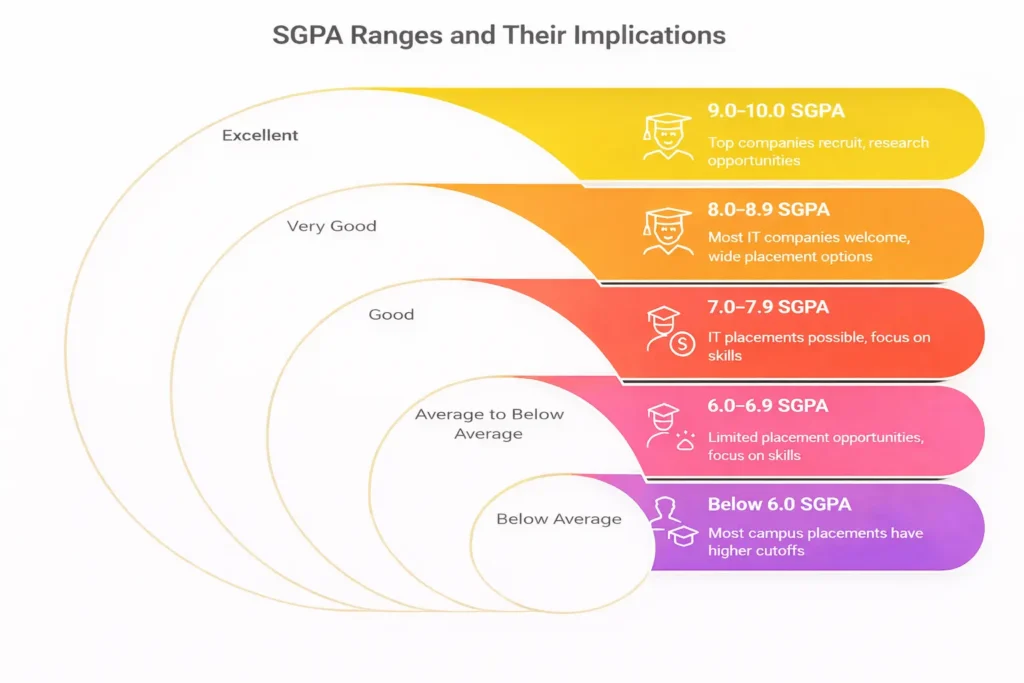
Let’s talk about what different SGPA ranges actually mean for your career.
IT Company Placement Requirements
What Different SGPA Ranges Mean
9.0-10.0 SGPA (82.5-92.5%)
You’re in the excellent category. Top companies actively recruit students with this range. Product-based companies like Google, Microsoft, and Amazon consider your applications. Research opportunities open up easily. Scholarship applications have high success rates.
Higher education abroad becomes easier. Top US universities prefer a 9.0+ SGPA. Funding opportunities increase significantly. Teaching assistant positions are more accessible.
8.0-8.9 SGPA (72.5-81.5%)
This is a very good performance. Most IT companies welcome your applications. Service-based and product-based companies both consider you. Campus placement options are wide open.
Master’s programs accept you easily. Good universities abroad consider your profile. Scholarship chances remain strong. Academic achievements support your applications.
7.0-7.9 SGPA (62.5-71.5%)
You’re in the good range. IT placements are definitely possible. Most service-based companies recruit from this bracket. Focus on building additional skills. Projects and internships become important.
Higher education options exist. Tier-2 universities abroad accept this range. Indian universities have good programs available. Build a strong overall profile.
6.0-6.9 SGPA (52.5-61.5%)
This is the average to below-average range. Some companies have cutoffs you can’t meet. Focus heavily on skills development. Certifications become very important. Projects and practical experience matter more.
Placement opportunities are limited but exist. Smaller companies and startups are options. Service-based IT companies with lower cutoffs remain open. Personal projects can strengthen your profile.
Higher education needs extra effort. Focus on entrance exams for Indian universities. Work experience before masters helps significantly.
Below 6.0 SGPA (Below 52.5%)
Most campus placements have higher cutoffs. Focus on the next semester immediately. Improve grades wherever possible. Build exceptional skills to compensate.
Consider off-campus applications after graduation. Startups value skills over grades. Build a strong portfolio of projects. Certifications from recognized platforms help.
Work experience before higher education is advisable. Practical skills matter more than grades in many fields. Don’t lose hope. Many successful professionals started here.
How much is 80% in SGPA?
80% equals approximately 8.75 SGPA. Calculate it backwards: (Percentage + 7.5) ÷ 10 = (80 + 7.5) ÷ 10 = 87.5 ÷ 10 = 8.75 SGPA.
This is excellent performance. You’re eligible for almost all campus placements. Top companies actively consider applications in this range.
For Study Abroad (US/UK/Canada)
Can someone calculate my SGPA?
Yes, you can calculate SGPA to percentage yourself. Here’s exactly how it works.
Understanding the Components
Step-by-Step SGPA to percentage Calculation Example
Let’s calculate SGPA for a real semester.
Subject | Credit Hours | Grade | Grade Points | Total Points |
Mathematics | 4 | A (9) | 9 | 36 |
Physics | 3 | B+ (8) | 8 | 24 |
Chemistry | 3 | A (9) | 9 | 27 |
Programming Lab | 2 | A+ (10) | 10 | 20 |
Totals | 12 | – | – | 107 |
Calculation: Total grade points earned = 107 Total credit hours = 12 SGPA = 107 ÷ 12 = 8.92
Converting to Percentage: Percentage = (8.92 × 10) – 7.5 = 89.2 – 7.5 = 81.7%
Why Credit Hours Matter
Grade Point Systems Across Universities
Check your grade sheet carefully. Note which scale your university uses. Apply the correct grade points for accurate calculation.
5 Proven Strategies to Improve Your SGPA
These strategies actually work. Students have used them to raise SGPAs by 0.5 to 1.5 points.
Focus on High-Credit Courses First
Look at your semester subjects. Identify courses worth 4 credits. These subjects have maximum impact on SGPA. Allocate more study time to high-credit courses. A one-grade improvement in a 4-credit subject equals more than two grades in a 1-credit course. The math favors strategic focus.
Example calculation helps understand this. Improving from B to A in a 4-credit course adds 4 points to your total. Improving from B to A in a 1-credit course adds just 1 point. Four times the impact from the same effort. Don’t ignore smaller courses completely. Just prioritize your time wisely. Study according to credit weightage
Don’t Ignore Easy Subjects
Lab courses are often easier to score in. Most students get an A or A+ in practical sessions. These are free grade boosters. Small improvements across all subjects add up fast. Going from B to B+ in three subjects beats going from B to A in one subject. Consistency matters more than excellence in one area.
Check past year question patterns. Some theory subjects have predictable questions. Standard textbook problems are repeated often. Easy marks are sitting there. Elective courses sometimes offer easier scoring. Choose electives wisely. Check with seniors about difficulty levels. Strategic subject selection helps SGPA.
Understand Grading Thresholds
Universities set mark ranges for each grade. Example: 90-100 marks = A+, 80-89 marks = A, 70-79 marks = B+. Know these thresholds for your university. Sometimes 2 extra marks mean jumping a full grade. That jump significantly impacts SGPA.
Focus effort on threshold boundaries. If you’re scoring 78 marks, push for 80. That gets you from B+ to A. One grade point increase. Worth the extra effort. Internal exams show your current standing. Calculate how many marks you need for the next grade. Set specific targets. Work towards those exact numbers.
Plan Your Semester Load Wisely
Don’t take all difficult courses in one semester. Mix hard and easy subjects. Balance your workload across semesters. Some semesters have naturally tough courses. Core engineering subjects cluster together. Plan lighter electives alongside them. Give yourself breathing room.
Summer semesters or winter terms offer chances. Take a few easier courses. Boost your SGPA when the load is lighter. Strategic planning across years helps. Credit distribution across semesters matters too. Don’t overload with 28 credits one semester. Spread them evenly. Consistent performance beats exhausted struggling.
Track Your Progress Throughout
Don’t wait for final results. Calculate potential SGPA after each internal exam. Know where you stand currently. Our calculator helps with scenario planning. Enter different grade combinations. See how they affect your final SGPA. Make informed decisions about study focus.
Create a semester tracking sheet. Update it after every exam. Adjust your strategy based on running calculations. Data-driven preparation works better than guessing. Check which subjects need more attention. If one course is dragging your SGPA down, allocate extra time there. Fix problems early. Last-minute panic doesn’t help.
Bonus Strategy: Form study groups for difficult courses. Explaining concepts to others improves your understanding. Group study for tough subjects, solo study for easier ones. Mix your approach based on course difficulty.
How do I convert SGPA to CGPA, and then CGPA to percentage?
This is a two-step process. Let’s break it down clearly.
Step 1: Converting SGPA to CGPA
CGPA is the average of all your semester GPAs.
Formula: CGPA = (Sum of all SGPAs) ÷ (Number of semesters)
Example: Your SGPA across four semesters:
Sum of SGPAs = 7.5 + 8.0 + 8.5 + 9.0 = 33.0 Number of semesters = 4 CGPA = 33.0 ÷ 4 = 8.25
Step 2: Converting CGPA to Percentage
Use the same formula as SGPA conversion for CGPA to Percentage Conversion.
Formula: Percentage = (CGPA × 10) – 7.5
Example: Your CGPA is 8.25 Percentage = (8.25 × 10) – 7.5 = 82.5 – 7.5 = 75.0%
Important Note
Some universities use a weighted CGPA calculation. They consider credit hours from each semester. This method is more accurate but complex.
For weighted CGPA:
- Multiply each semester’s SGPA by its total credits
- Add all these products
- Divide by total credits from all semesters
Most universities provide CGPA directly on transcripts. You don’t need to calculate manually. Use the official CGPA value for percentage conversion.
Need CGPA to percentage conversion? Use our dedicated CGPA calculator. It handles both weighted and simple calculations.
SGPA vs CGPA vs GPA – What’s the Difference?
Students often confuse these three terms. Here’s the clear breakdown.
Quick Comparison Table
Aspect | SGPA | CGPA | GPA |
Full Form | Semester Grade Point Average | Cumulative Grade Point Average | Grade Point Average |
Time Period | One semester (4-6 months) | All semesters combined | Varies by country |
Common Scale | 10.0 in India | 10.0 in India | 4.0 internationally |
Used For | Semester performance tracking | Overall degree performance | International applications |
Appears On | Semester grade sheets | Final transcripts | Varies by institution |
SGPA is important for:
CGPA is important for:
GPA (4.0 scale) is important for:
Understanding the Scales
How to Convert Between Them
SGPA to CGPA: Average all semester SGPA. Simple arithmetic mean.
CGPA/SGPA to Percentage: Use (GPA × 10) – 7.5 for the Indian scale.
Indian GPA to 4.0 Scale: Approximate conversion:
Different universities abroad have different conversion methods. Check specific university websites. Some provide their own conversion calculators.
Frequently Asked Questions
Conclusion – Get Your Percentage in Seconds
Converting SGPA to percentage shouldn’t be complicated. You need accuracy for placements, admissions, and job applications. Our calculator delivers both. Whether you’re from VTU, Anna University, JNTU, or any other institution, get instant results. The calculator handles university-specific formulas. No manual calculations needed. No room for errors.
Your academic percentage opens doors. Company eligibility, scholarship applications, and higher education admissions all depend on it. Know your exact percentage. Plan your applications confidently.
Ready to convert? Use our calculator at the top of this page. Enter your SGPA. Get your percentage in under 5 seconds. Save the results. Share with friends who need it.
Need more conversions? Check our CGPA to Percentage calculator for overall grades. Try our Percentage to CGPA converter for reverse calculations. Bookmark this page for future reference.
Questions about your specific university formula? Read the university-specific section above. Still confused? Leave a comment below. We respond within 24 hours. Your next semester starts soon. Track your SGPA regularly. Set clear percentage goals. Work strategically towards improvement. Small changes in SGPA mean big differences in opportunities.
Good luck with your placements and admissions.