
Best Free GPA Calculator for Instant Semester Result
A fast and reliable GPA calculator built to simplify your academic calculations. Get accurate results instantly with a smooth and user-friendly interface.
✅ Fast and accurate GPA calculation in seconds

🎓 Universal GPA Calculator
Choose your grading scale & calculate accurately
Our GPA calculator helps you compute your semester GPA, cumulative GPA, or weighted GPA using accurate academic formulas. You only need your course grades and credit hours. The tool calculates your result automatically based on the standard 4.0 GPA scale or the grading system your institution follows.
This calculator works for:
You do not need to manually apply formulas. The system calculates:
GPA = Total Quality Points ÷ Total Credit Hours
All grade points are weighted by credit hours to ensure accuracy.
Enter Your Courses, Credits, and Grades
To calculate correctly, enter the following:
1. Course Name (Optional)
This helps you track subjects, but it does not affect the calculation.
2. Credit Hours
Each course has assigned credit hours. These act as a weight in the GPA formula. A 4-credit course affects your GPA more than a 2-credit course.
3. Letter or Numeric Grade
The tool converts your letter grade (A, B, C, etc.) into numeric grade points based on the grading scale.
Example (4.0 GPA scale):
The system multiplies grade points by credit hours to calculate quality points.
Add Multiple Semesters (Optional)
If you want to calculate a cumulative GPA, you can add multiple semesters.
You may enter:
The calculator combines all semesters to calculate your cumulative GPA using total quality points and total credit hours across terms.
This method works for:
GPA Updates Automatically
The calculator updates results in real time.
As soon as you adjust grades or credit hours, your updated GPA appears instantly
What Is GPA? (Grade Point Average)
A GPA calculator is built around one core academic metric: grade point average (GPA). GPA measures your academic performance by converting grades into numeric values and averaging them based on credit hours.
Schools, colleges, and universities use GPA to evaluate consistency, eligibility, and academic standing. It provides a standard way to compare performances across courses.
GPA is typically calculated on a
Meaning of GPA in School and College
In school and college, GPA represents the average of your grade points over a specific period.
Institutions use GPA to determine:
A higher GPA indicates stronger academic performance across subjects.
Difference Between GPA, SGPA, and CGPA
Students often confuse GPA, SGPA, and CGPA. The difference depends on the time span measured.
Both SGPA and CGPA use the same formula:
Total Quality Points ÷ Total Credit Hours
The only difference is the number of semesters included.
GPA vs SGPA vs CGPA (Quick Comparison Table)
Term | Full Form | Covers | Used For |
GPA | Grade Point Average | Any academic period | General performance |
SGPA | Semester Grade Point Average | One semester | Term evaluation |
CGPA | Cumulative Grade Point Average | All semesters combined | Overall academic record |
Understanding this difference helps you use the correct calculation method and choose the right calculator type.
How Is GPA Calculated? (Step-by-Step Guide)
A GPA calculator follows a precise academic formula. Every institution calculates GPA using total quality points divided by total credit hours. The method stays consistent across schools, colleges, and universities, although grading scales may vary.
Understanding the formula helps you verify your results and calculate manually when needed.
GPA Calculation Formula
The standard formula is:
GPA = Total Quality Points ÷ Total Credit Hours
Step-by-step process:
- Convert each letter grade into grade points.
- Multiply grade points by credit hours for each course.
- Add all quality points together.
- Add all credit hours together.
- Divide total quality points by total credit hours.
This produces your semester GPA.
To calculate cumulative GPA, include all semesters in the totals.
What Are Grade Points and Credit Hours?
Grade Points
Each letter grade corresponds to a numeric value based on the grading system.
On a 4.0 GPA scale, the typical values are:
Some institutions use plus/minus grading (e.g., B+ = 3.3, A- = 3.7).
Credit Hours
Credit hours represent the weight of a course. A 4-credit course impacts GPA more than a 2-credit course because it carries more academic weight. Grade points × Credit hours = Quality Points
Example GPA Calculation
Assume you completed four courses:
Course | Grade | Grade Points | Credit Hours | Quality Points |
Math | A | 4.0 | 3 | 12.0 |
English | B | 3.0 | 3 | 9.0 |
Science | B | 3.0 | 4 | 12.0 |
History | C | 2.0 | 2 | 4.0 |
Step 1: Add Quality Points
12.0 + 9.0 + 12.0 + 4.0 = 37.0
Step 2: Add Credit Hours
3 + 3 + 4 + 2 = 12
Step 3: Divide
37 ÷ 12 = 3.08 GPA
This is your semester GPA.
To calculate cumulative GPA, repeat the same process, including previous semesters’ totals.
GPA Grading Scale (4.0, 4.3 & Weighted GPA)
A GPA calculator depends on the grading scale your institution uses. While the calculation formula stays the same, the grade point values can differ based on whether the school follows a 4.0 scale, a 4.3 scale, or a weighted system.
Understanding your grading scale ensures accurate GPA calculation.
Standard 4.0 GPA Scale
The 4.0 GPA scale is the most widely used grading system, especially in U.S. schools and universities.
Letter Grade | Grade Points |
A | 4.0 |
A- | 3.7 |
B+ | 3.3 |
B | 3.0 |
B- | 2.7 |
C+ | 2.3 |
C | 2.0 |
C- | 1.7 |
D | 1.0 |
F | 0.0 |
This system forms the foundation of most GPA and CGPA calculations.
4.3 GPA Scale (A+ System)
Some institutions use a 4.3 GPA scale where an A+ carries extra value.
Example:
Letter Grade | Grade Points |
A+ | 4.3 |
A | 4.0 |
A- | 3.7 |
In this system, students can earn slightly above 4.0 if they consistently receive A+ grades.
Always confirm your institution’s grading system before calculating.
Weighted vs Unweighted GPA
High schools often use weighted GPA systems for advanced courses.
Unweighted GPA
Weighted GPA
A weighted GPA Calculator reflects academic rigour, not just grades.
GPA Scale Conversion Table
System | Maximum GPA | Common Usage |
4.0 Scale | 4.0 | Standard U.S. colleges |
4.3 Scale | 4.3 | A+ grading institutions |
5.0 Weighted | 5.0 | High school AP/Honors |
CGPA out of 10 | 10.0 | Many international universities |
If your institution uses a CGPA out of 10, convert carefully before applying any GPA conversion formula.
Which GPA Calculator Do You Need?
Not every student calculates grades the same way. A GPA calculator must match your academic system, grading scale, and course structure. High school students, college students, and international learners often follow different grading methods.
Choosing the correct calculator ensures accurate semester GPA, cumulative GPA, or CGPA results.
GPA Calculator by Student Type
Different academic levels require slightly different inputs and grading considerations.
High School Students
College Students
International Students
Always confirm your institution’s grading system before using any conversion method.
Calculator Type Comparison Table
Student Type | Recommended Calculator |
High School | Weighted / Unweighted GPA Calculator |
College | Semester & Cumulative GPA Calculator |
International | CGPA Calculator or GPA Conversion Calculator |
If your institution uses a credit-based system, enter accurate credit hours. If it uses percentage-based grading, convert the percentage to GPA carefully using the approved formula.
What Your GPA Means (Academic Standing Guide)
A GPA calculator gives you a number, but that number reflects your academic standing. Schools and universities use GPA to evaluate performance, determine eligibility, and monitor progress toward graduation.
Understanding GPA ranges helps you interpret your results correctly.
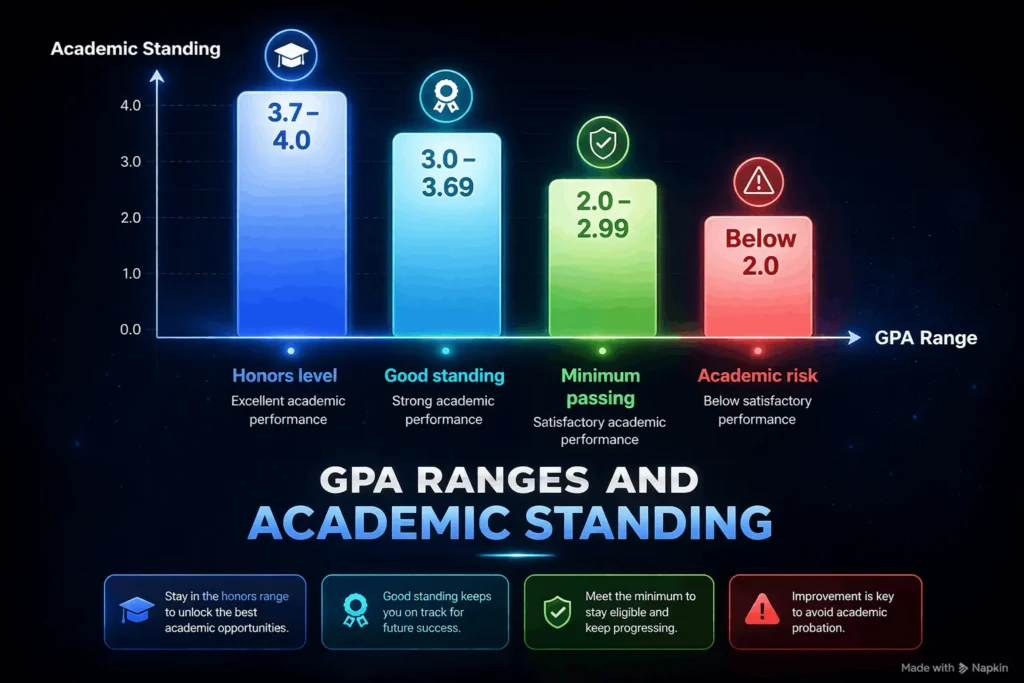
GPA Ranges Explained
While standards vary by institution, most follow general academic categories on the 4.0 GPA scale.
3.7 – 4.0
3.0 – 3.69
2.0 – 2.99
Below 2.0
For institutions using CGPA out of 10, equivalent interpretation depends on the official conversion policy.
GPA Range vs Opportunities Table
GPA Range | Academic Standing | Opportunities |
3.7 – 4.0 | Honors level | Scholarships, Dean’s List |
3.0 – 3.69 | Good standing | Internship eligibility |
2.0 – 2.99 | Minimum passing | Graduation eligible (varies) |
Below 2.0 | Academic risk | Probation warning |
Always check your institution’s academic handbook for official thresholds.
GPA Exceptions You Should Know About
A GPA calculator works accurately when all grades follow standard rules. However, some academic situations affect how GPA is calculated. Universities apply specific policies for special grades and course outcomes.
Before calculating your GPA, review these common exceptions.
Pass / Fail Courses
Pass/Fail courses usually do not affect GPA.
Pass (P): Credits may count toward graduation but do not add grade points.
Fail (F): Some institutions count this as 0.0 in GPA calculation.
Always confirm whether a failing pass/fail grade impacts your cumulative GPA.
Withdrawals (W vs WF)
Withdrawal grades appear when a student leaves a course.
W (Withdrawn): Typically does not affect GPA.
WF (Withdrawn Fail): Often calculated as 0.0 and impacts GPA.
Policies vary by institution, so check official academic guidelines.
Retaken Courses
If you repeat a course
Some institutions replace the old grade.
Others average both attempts.
Grade replacement can significantly change your semester GPA and cumulative GPA.
Transfer Credits
Transfer credits usually
Count toward degree requirements
Do not affect GPA at the new institution
However, some universities include transfer grades in the cumulative GPA. Confirm your institution’s transfer policy before calculating
Incomplete (I) Grades
An Incomplete (I) is temporary
It does not affect GPA until a final grade is submitted
Once updated, the new grade applies to the GPA calculation
Do not include incomplete grades unless they have been officially finalized.
Understanding these exceptions ensures your GPA calculation reflects your true academic record.
How to Raise Your GPA (Smart Strategies)
A GPA calculator shows your current academic standing, but you can actively improve that number. GPA increases when you earn higher grade points in credit-weighted courses. Strategic planning helps you improve efficiently rather than randomly.
Below are practical methods that directly affect semester and cumulative GPAs.
Focus on High-Credit Courses
Credit hours determine how much a course affects your GPA.
Prioritize preparation for courses with higher credit weight. Strong performance in these classes earns more total quality points.
Retake Low-Grade Classes
If your institution allows grade replacement:
Before retaking, confirm whether your school uses:
This difference determines how much your GPA improves.
Improve Study & Time Management
Academic consistency improves GPA over time.
Improvement in even one letter grade per subject can shift GPA meaningfully across a semester.
GPA Planning Calculator (Target GPA)
To plan improvement:
- Identify your current cumulative GPA.
- Estimate upcoming semester credit hours.
- Set a target semester GPA.
Example:
If your current cumulative GPA is 2.8 and you complete 15 credit hours with a 3.6 semester GPA, your cumulative GPA will increase based on the weighted formula:
New CGPA = (Old Quality Points + New Quality Points) ÷ Total Credit Hours
Strategic semester planning helps you reach scholarship thresholds, honors eligibility, or graduation requirements.
FAQs
Final Thoughts – Track, Plan, and Improve Your GPA
A GPA calculator helps you measure academic performance using accurate credit-hour weighting and grade point formulas. Track your semester GPA, monitor cumulative GPA, and plan improvements before grades become final.
Understand your grading scale, enter correct credit hours, and review results regularly. Small improvements each semester can significantly raise your overall GPA over time.